

By Simisola Ogunremi
Young people from across Nigerian universities have been urged to challenge misogyny, confront harmful gender stereotypes and take a stand against technology-facilitated gender-based violence (TFGBV), both online and offline.
The call was made at a peer-to-peer awareness session organised by Journalists for Christ (JFC) at the International Press Centre (IPC), Ogba, Lagos. The session brought together students from Osun State University, Lagos State University (LASU), University of Lagos (UNILAG), University of Benin (UNIBEN) and Caleb University.
Supported by the World Association for Christian Communication (WACC) and Bread for the World, the German Protestant Agency for Diaconia and Development, the engagement focused on helping young people recognise misogyny, understand online gender-based abuse and learn how to respond safely when confronted with such behaviour.
The central message was that gender should never be a barrier to opportunity, leadership or self-expression, while harmful attitudes towards women and girls must no longer be dismissed as normal.
*When gender becomes a barrier to leadership*
Participants shared personal experiences and observations that exposed how gender stereotypes continue to influence campus life, leadership contests and relationships among young people.
One participant recounted the experience of a female student contesting for Sports Director at her university. Despite years of active service in the sports department and several awards, she faced a male first-year student whose stated achievement was his involvement in sports during secondary school.
According to the participant, several men in the audience appeared to favour the male candidate because they believed the position should be occupied by a man rather than a woman.
The account illustrated how women can be disadvantaged even when their qualifications and experience appear stronger.
Another participant, described how a fellow woman discouraged her ambitions, telling her to lower her expectations because women before her had never attained similar heights in their department.
The experience raised questions about how discriminatory attitudes can be reinforced by women themselves, particularly when long-standing stereotypes are accepted without challenge.
A participant captured this concern by observing that women sometimes undermine one another rather than act as “a sister’s keeper. ”
The discussion stressed that challenging misogyny requires more than calling out men. Women must also question attitudes that discourage other women from pursuing leadership, professional growth and personal aspirations.
‘ *Are Women too emotional to lead?’*
Participants also examined how misogyny is often disguised as humour, ordinary conversation or seemingly harmless banter.
Expressions such as “women are too emotional to lead” and jokes that reduce women’s opinions to their physical appearance were cited as examples of language that can reinforce discrimination
.
The facilitators warned that when such remarks are repeatedly excused as jokes, they help sustain the belief that women are less capable of leadership or decision-making.
Misogyny was explained as prejudice, contempt or hostility directed at women and girls because of their gender. It can manifest through sexist stereotypes, degrading language, discrimination and attempts to silence or control women. The discussion emphasised the need to examine personal assumptions and challenge beliefs that limit women’s potential.
*Sharing private images is abuse, not an achievement*
The dangers of technology-facilitated gender-based violence also featured prominently during the session.
One participant recounted an incident in which a young man allegedly shared a young woman’s private videos and photographs in a class group chat after a date, presenting the act as an achievement.
The facilitator identified the conduct as image-based abuse, stressing that intimate images must not be shared without the consent of the person depicted. The incident highlighted how digital platforms can turn a private violation into public humiliation, exposing victims to further harassment, emotional distress and reputational damage.
Participants were reminded that the responsibility to prevent abuse extends beyond the person who originally creates or uploads harmful content. Anyone who forwards, celebrates or encourages its circulation can contribute to the harm.
Technology-facilitated gender-based violence was explained as abuse carried out, enabled or amplified through digital technologies. It includes cyberstalking, online sexual harassment, doxxing, sextortion, impersonation through fake accounts, AI-manipulated content and the non-consensual sharing of intimate images.
The facilitators noted that such abuse can occur on platforms including WhatsApp, Instagram, TikTok, X, Snapchat and Facebook, as well as dating applications, campus forums and class group chats.
*‘There is a real person behind the screen’*
The session urged young people to become more responsible digital citizens, particularly in their use of social media. Participants were cautioned against circulating unverified information, sharing private material or making comments that could expose others to humiliation or abuse.
Using JFC’s peer-to-peer factsheet, the facilitators introduced a practical “pause” test to help participants assess what they intend to post or forward:
• Is it true?
• Is it necessary?
• Is it respectful?
• Could it cause harm?
• Do I have permission to share it?
The guiding advice was simple: if in doubt, do not forward it.
Another participant warned that many young people share too much personal information online without considering how it might later be used against them. The discussion encouraged participants to protect their accounts, devices and personal information while exercising greater care over what they make publicly available.
In response, the facilitator encouraged participants to consider appropriate reporting channels rather than relying solely on social media to resolve serious allegations. She discussed reporting to the police and seeking assistance from relevant government agencies, non-governmental organisations and advocates where necessary.
She cautioned that taking a case directly to the internet might expose those involved to reputational harm, speculation or advice that could worsen the situation.
The discussion emphasised the importance of protecting privacy, preserving relevant evidence where safe to do so, avoiding victim-blaming and seeking appropriate, confidential and survivor-centred assistance.
*Four steps for responding to online abuse*
Participants were introduced to a four-step response framework in JFC’s factsheet to help them act when confronted with technology-facilitated abuse.
Stop: Do not participate in, encourage or amplify abusive behaviour.
Secure: Protect accounts, devices and personal information.
Report: Use appropriate platform reporting mechanisms and relevant institutional or legal channels.
Support: Listen without judgement, check in on the affected person and help them access appropriate assistance.
The framework encouraged participants to move beyond recognising abuse to taking practical steps to prevent further harm and support those affected.
*Change can begin from a small gathering’*
As the session drew to a close, one participant observed that however small a gathering might be, it could still be the starting point for meaningful change.
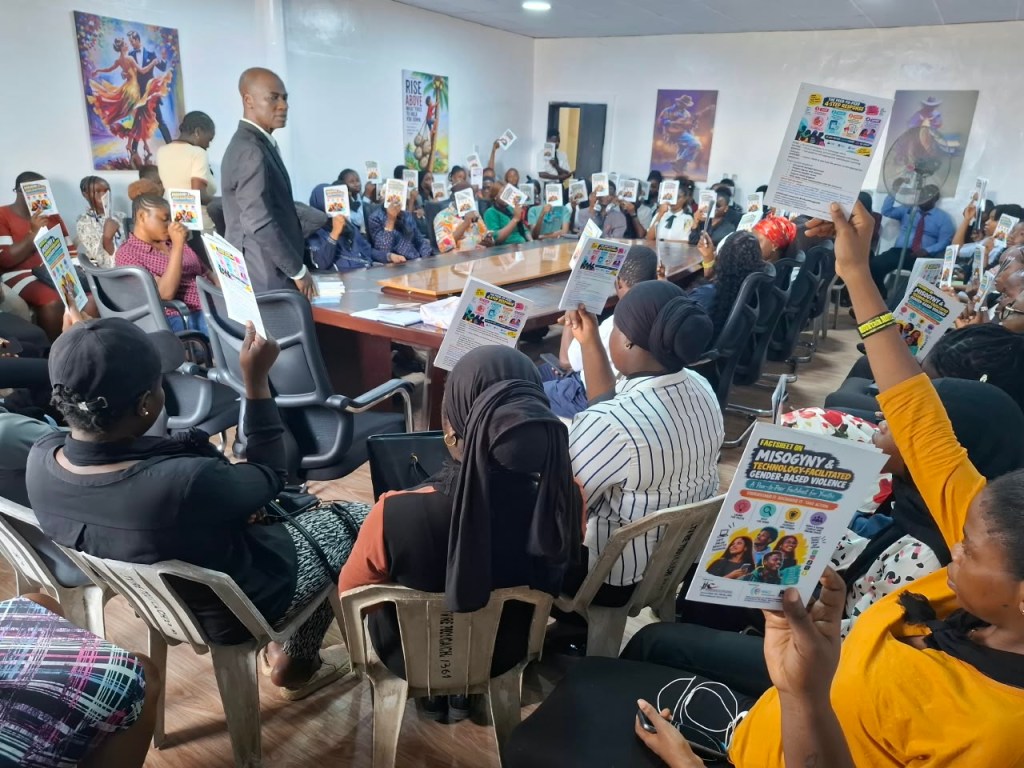
The observation captured the spirit of the engagement, which sought to empower young people to challenge discriminatory attitudes in their immediate environments and online communities.
The session also highlighted that women can sometimes perpetuate misogyny by discouraging other women, reinforcing the need for solidarity and collective responsibility.
Among those present were the President of Journalists for Christ, Mr Lekan Otunfodunrin; Mr Sanmi Falobi, a JFC member and Project Manager at the International Press Centre. Simisola Ogunremi and Oluwaseyi Elizabeth Jimoh facilitated the session.
The programme ended with brief remarks by the JFC President, who spoke about the organisation’s mission and the importance of raising global awareness among young people.
Through the engagement and its accompanying factsheet, JFC sought to equip participants with the knowledge and practical tools to recognise misogyny, challenge harmful gender norms and respond responsibly to technology-facilitated abuse.
The message from the session was clear: young people have a responsibility to stop normalising discrimination, refuse to amplify online abuse and help build communities where women and girls can participate, lead and express themselves without fear.

