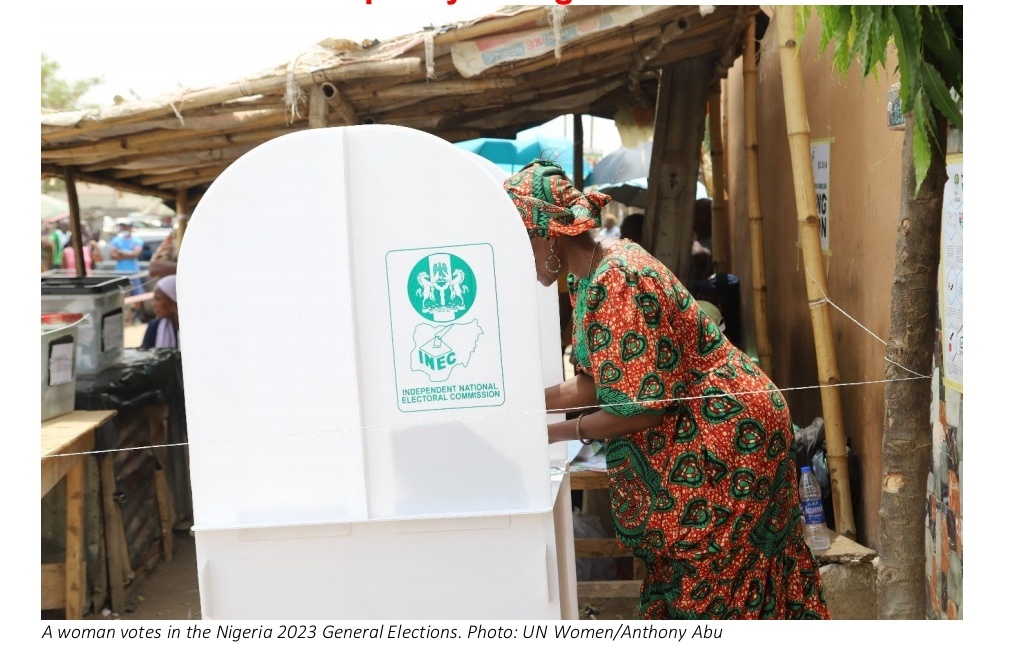
As 2027 election campaigns gather momentum, United Nations, UN Women Nigeria has launched the #VoteHer2027 campaign, calling on
Nigerians to vote without gender bias in the general elections.
The organisation also called on the electorate to judge candidates by their competence, integrity, experience and plans for the country—not by whether they are women or men.
The organisation revealed that Women account for just 9.7 per cent of candidates for the 2027 general elections. Even if every woman
candidate wins, women’s representation would remain far below equal participation. The figures underline the scale of the challenge facing Nigeria, where women make up nearly half the population but remain severely underrepresented in elected office.
In a press statement, the organisation said that Women’s representation is not simply a political issue; it is a matter of fairness, equal rights and social
justice. Decisions made by elected leaders affect everyone, and women must have a fair chance to help
shape the laws, policies and priorities that govern their lives and communities. Women should not be
elected simply because they are women, but neither should they be rejected because of their gender.
Nigeria’s commitment to women’s political representation is also grounded in international and national
frameworks. The country has ratified the Convention on the Elimination of All Forms of Discrimination
Against Women (CEDAW) and the Maputo Protocol, and adopted the Beijing Platform for Action, all of which advance women’s equal participation in decision-making. Nigeria’s National Gender Policy
reinforces these commitments by providing for affirmative action and setting representation targets
ranging from 30 percent to 50 percent.
A key part of the campaign is NO BE BY GENDER, an issue-based radio drama and expert call-in programme
on Radio Nigeria Network. Through relatable stories and conversations with experts and gender
advocates, the programme will examine the stereotypes, myths and socio-cultural barriers that
discourage support for women in leadership. It will invite listeners to question their assumptions and
assess candidates on their ideas, record and ability to serve.
The campaign will also use social media and work with UN Women’s media partners to bring experts and
gender advocates into public discussions on women’s political participation, challenge discriminatory
narratives and promote fair media coverage of women candidates.
If more women are not elected, Nigeria risks deepening the gender gap in governance and sending a
troubling message about its commitment to equality and democratic representation. With women making
up only 9.7 per cent of candidates, the country cannot afford to compound their underrepresentation
with gender prejudice at the ballot.
UN Women Nigeria calls on the public, political and traditional leaders, influencers, civil society
organisations and the media to intensify advocacy for unbiased voting in 2027. The media should
challenge stereotypes and give women candidates fair coverage; influencers and community leaders
should confront discriminatory attitudes; and citizens should look beyond gender when deciding whom to vote for.

