LASG to partially close Opebi road for construction of collector drain

By sdnonline

The Lagos State Government will partially close Opebi Road for the next stage of construction of the Collector Drain that will deflood the corridor for two weekends, starting from Friday 23rd to Sunday 25th of April and Friday 30th April to Sunday 2nd May, 2021.

In a statement by the Commissioner of Transportation, Dr. Frederic Oladeinde said that the next phase which has been indicated as the final stage by the contractor would require introduction of Box Culvert across Opebi road by Chrisland School.

He explained that the first half of the culvert will commence on Friday night, 23rd and be completed on Sunday, 25th of April, while the second and final half of the culvert will start on Friday 30th April and finish on Sunday 2nd of May, 2021.

The Commissioner also disclosed that the lane under construction will be barred from vehicular movement as a counter flow would be created on the other lane to allow vehicles access their desired destinations.

The statement further assured that Traffic Management Personnel will be on ground to manage movement during this period while seeking the cooperation of motorists to minimize inconveniences during the course of the construction.

The State Government once again appeal to the motoring public to obey all traffic laws and employ patience and calm in their use of the road during and beyond construction durations.

Lawyers urge FG to domesticate regional and international instruments on the safety of journalists

By sdnonline

Participants rising from a Litigation Workshop for Lawyers on the Safety of Journalists have called on the Federal Government to take urgent steps to domesticate relevant regional and international instruments and standards on the safety of journalists in order to give impetus to compliance and enforcement processes at the national level as a way of ending impunity for crimes against journalists.

They also urged government to live up to its international treaty obligation to guarantee the safety of journalists and other media practitioners, including by preventing attacks on them whenever possible and ensuring that all attacks on journalists and other media workers are investigated and that the perpetrators of the attack are prosecuted and punished.

These were some of the recommendations made by legal practitioners who participated in a two-day Litigation workshop on Safety of Journalists held in Abuja organized by Media Rights Agenda (MRA) with support from the Global Media Defence Fund (GMDF) through the United Nations Educational, Scientific and Cultural Organization (UNESCO).

The participants urged media organizations in Nigeria to undertake periodic and regular safety training for their journalists and other workers to ensure that they are able to carry out their work safely and professionally, adding that the organizations should also kit journalists and workers with the appropriate equipment, including protective gear, where necessary, to prevent or minimize their exposure to various hazards that they may confront as they carry out their work.

They advised lawyers and civil society organizations to liaise with relevant organizations, institutions and agencies, such as the National Judicial Institute (NJI), the Nigerian Institute of Advanced Legal Studies (NIALS), the Nigerian Bar Association (NBA) as well as the heads of various courts in organising sensitization programmes and activities for judicial officers on the safety of journalists so that judges are appropriately informed about the importance of the safety of journalists and their role in the process.

The participants suggested that lawyers litigating cases touching on the safety of journalists and other media workers should prepare their written addresses or briefs of argument with the objective of enlightening and sensitizing the judge handling such matters about the issue of the safety of journalists, adding that they should also prepare diligently for their cases and familiarize themselves sufficiently about the issue in order to adequately respond to questions or queries that the judges may raise.

In order to ensure speedy adjudication, the participants pointed that for cases touching on the safety of journalists in Nigeria as well as to ensure that judges handling such matters have the requisite knowledge and expertise, the heads of various courts in the country should designate judges to hear cases on the safety of journalists.

Besides, they said, as part of efforts by Nigeria to meet its obligations under regional and international instruments to prevent attacks against journalists and ensure accountability for any such crimes, “Practice Directions” should be issued to guide the hearing and determination of such cases in order to improve the effectiveness of judicial mechanisms in addressing the challenge of crimes against journalists.

The participants said it was a shocking irony that attacks on the media, particularly the killing of journalists, have escalated during the period of civilian democracy with the result that attacks on journalists have risen far above the levels recorded during the period of military regimes in Nigeria, pointing out that it means that the democratic environment has become far more hostile and dangerous for journalists than the period of military rule.

They pointed out that if journalists are frequently intimidated into distorting the information that they provide to the society or if they are too afraid to report truthfully and accurately because of constant attacks, legal practitioners and the entire society will be worse for it because most, if not all members of the public make serious and sometimes life-changing economic, political, professional and other decisions based on the information that they receive through journalists and the media.

In the light of this, the participants noted, lawyers have a self-interest in ensuring that journalists and the media have a conducive and enabling environment to practice their profession so that they can continue to provide members of the public with news and information that is reasonably accurate and reliable and that in turn enables the lawyers and other members of the public to make good and informed decisions.

Nigeria lacks adequate shelters for victims of GBV, violated women, girls

-By Funmi Falobi @ sdnonline

While nations of the world grapple with the issue of gender-based violence (GBV), the challenge has however increased as the world battles with the coronavirus pandemic. With the Covid-19 pandemic, there has been increase in sexual harassment, rape and violence against women and girls and the number has risen during the lockdown globally. The United Nations has called it ‘shadow pandemic.’

Like the rest of the world, Africa is not spared in the increase of gender-based violence. Liberia recorded a 50 percent increase in the first half of 2020, which is 0ver 600 reported rape cases. In Kenya, almost 4000 school girls were reported becoming pregnant during the lockdown. South Africa which is said to have the highest statistics of GBV in the world also experienced upward trend in violence against women during the lockdown.

Data also reveals that Nigeria records monthly increase of gender based violence during the lockdown.

While the Federal Government of Nigeria has ratified multiple international laws and conventions to address the historical discrimination and marginalization of women and girls, including GBV, the problem is still there.

Amidst the growing statistics, a major need of abused or violated women and girls is a home that provide succor to assuage their plight.

According to an ongoing research by leading GBV response organization, Project Alert, Nigeria has less than 20 women’s shelters and even then, private organisations and religious institutions run them.  Despite Nigeria having the largest population in Africa, it lacks adequate shelter to cater for the needs of victims of gender-based violence. Indeed, the provision of shelter for victims of GBV by the Government is extremely inadequate.

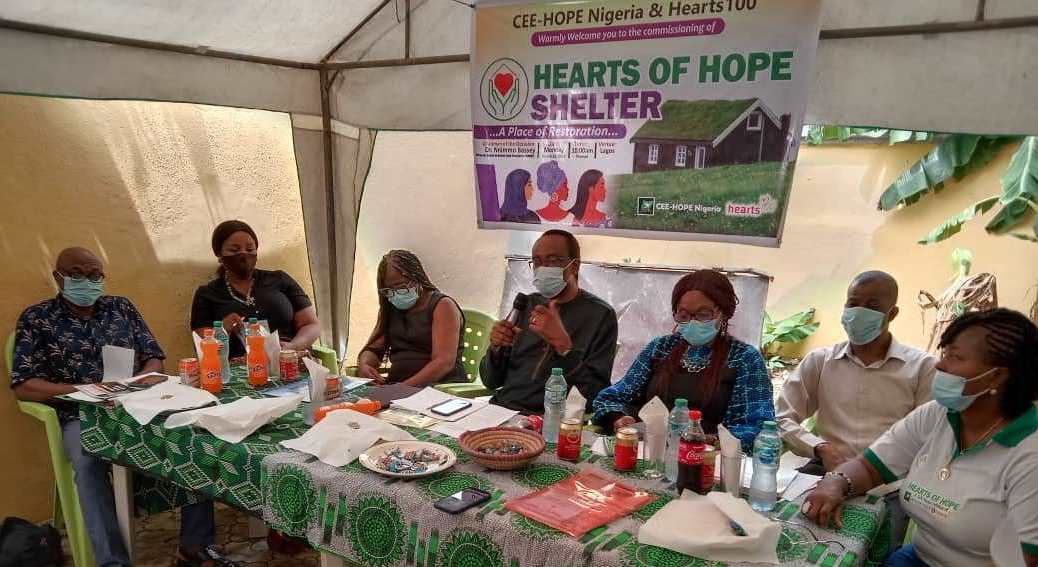
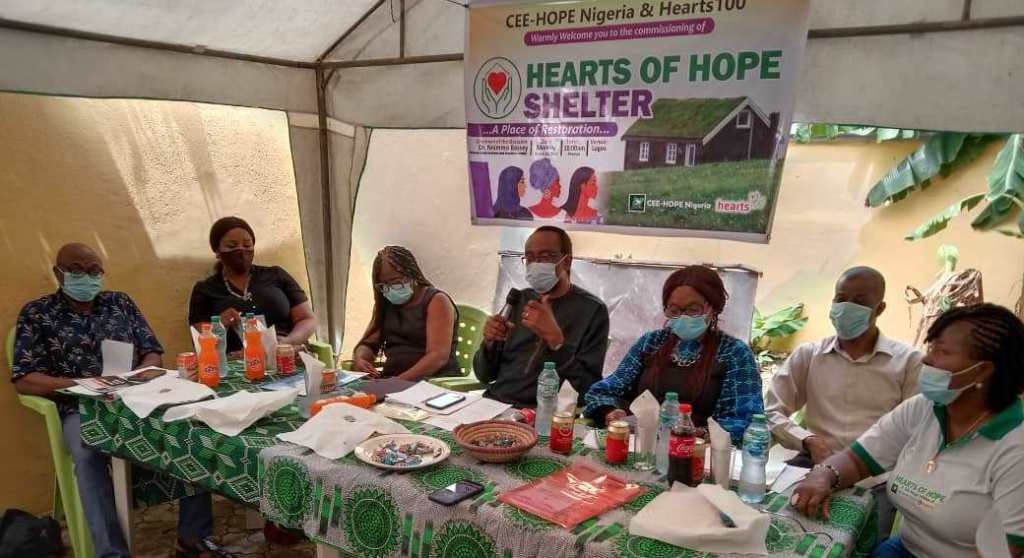
As part of efforts to ameliorate the suffering of victims of GBV and provide succour for them, the Centre for Children’s Health Education, Orientation and Protection (CEE-HOPE and HEARTS100 Initiative has established a Heart of Hope Shelter, a home to provide temporary shelter, counseling support and empowerment for affected women and girls.

Speaking at the commissioning of the home in Lagos, Executive Director, CEE-HOPE, Betty Abah  declared that when you compare Nigeria population of over  200 million to developed nations of Canada and United Kingdom with population of 37 and 66million respectively, Nigeria can only boast of  less than 20 shelters while Canada has 400 women’s shelters and UK has over 300 shelters  aside homeless and animal shelters.

This is a screaming clarion call to our government at the various levels, private institutions, and public-spirited individuals to take the need for setting up of shelters as a major priority.

Government shelters are very, very few and far in-between. As it is with government business, even the very few run by government are mostly on life support. Most of them are perennially deprived of qualified staff, food for residents and generally running at low and negligible budgets, if ever they exist. Besides the Lagos State and Ekiti State governments, which are doing credible work in response to GBV and have some of these infrastructure and legal mechanism in place, most other states in Nigeria are performing woefully in that front, “she said.

She explained that many women and girls are still trapped in the age-long practice of Female Genital Mutilation (FGM) but due to government’s failure to implement and enforce available laws, the practice still thrives in most states.

As we all know, Covid-19 has come, not only as a killer of humans and destroyer of the global economy, but has also led to a global spike in GBV. Incidences of Intimate Partner Violence, physical battery, sexual violence and all sorts of domestic violence arise. It is for this reason that GBV has long been tagged ‘an epidemic within an epidemic’ and as usual, women and girls are the major victims.”

In his address, Dr. Nnimmo Bassey, Director, Health of Mother Earth Foundation (HOMEF) as well as representative of Heart100 harped on relationship as the most valuable thing with other people.

Heart100 came into existence last year due to situations around vulnerable women and children around the world as a result of covid-19. The founders continue to ensure all can live in dignity and make their voice heard.”

Mrs. Josephine Evah-Chukwuma, Executive Director, Project Alert and founder of the first women shelter in Nigeria, Sophia’s Place charged the founder of the shelter that passion and commitment will see her through.

While confirming the dearth of shelters in the country she said, ” It’s not going to be an easy thing. Shelters are one of the needed facilities for victims of GBV but passion and commitment will see you through.”

PPJ urges govt to implement, strengthen gender sensitive laws

=By sdnonline=

The Priests Peace and Justice Initiative (PPJ) joins the rest of the World to celebrate the International Women’s day (IWD) and calls on Nigerians to challenge gender inequality and the Federal Government to implement and strengthen gender sensitive laws that will provide support for gender issues and eliminate gender discrimination in Nigeria.

In a press statement issued in Abuja by Dr. Otive Igbuzor, Programme Director, to commemorate this year’s international women’s day, the organization said “Women all over the world want and deserve an equal future free from stigma, stereotypes and violence; a future that’s sustainable, peaceful, with equal rights and opportunities for all. To get us there, Nigeria needs women at every table where decisions are being made.”

In this year’s International Women’s Day, PPJ wants to celebrate the exceptional work of women around the world; especially the Christian Women Against Corruption which is one of the campaign platforms for the Shun Corruption Project for setting a positive example, showing that women are not only victims of corruption, but also key players in the struggle against it.

According to him while corruption affects people across all genders, ages and races, it hits poor and vulnerable groups the hardest, especially women. Gender-specific forms of corruption deepen inequality, hinder women’s empowerment, and are a violation of human rights.

He said that although women’s full and effective participation in all areas of life will drive progress for everyone, women are still underrepresented in public life and decision-making processes saying at the current rate of progress gender equality among Heads of Government will take another 130 years. “When women lead, we see positive results and women, especially young women, are at the forefront of diverse and inclusive movements online and on the street for social justice and gender equality in all part of the world. Yet, women under 30 are less than 1 percent of parliamentarians worldwide,” he said.

Expressing support for this year’s theme, he said the IWD is a rallying cry for Nigerians to choose to challenge gender bias and stereotypes saying that individually, we are all responsible for own thoughts and actions – all day, every day. We can all choose to challenge and call out gender bias and inequality and collectively, we can help create an inclusive world.

Dr. Igbuzor also stated that; “the marginalization of women in economic development and in social and political spaces is a worldwide phenomenon; however, it is worst in developing countries. In Nigeria, despite the adoption of the United Nation’s convention on the elimination of all forms of discrimination against women in 1985 and similar local policies, such as the National Gender Policy of 2006, inequality still exists due to myriad of cultural and structural challenges.”

He emphasized that this has constrained women’s participation in all spheres of life with serious implication for human resource development and, in that capacity, economic development of the country and the general state of gender equality and referred to research over the years which has shown that women lay behind men in most indicators of socio – economic development and they constitute most of the poor, the unemployed and the socially disadvantaged.

According to him, the Nigerian Constitution which abhors and prohibits gender – based discrimination, does not protect women’s rights. He said an ideal Constitution should have been drafted with the input of every segment of society, but the 1999 Charter was made without consulting Nigeria’s women, and its language reflect this imbalance. Citing Section 26 of the Constitution he said that a foreign woman married to a Nigerian man is eligible for Nigerian citizenship, but the same right is not granted to a foreign man married to a Nigerian woman.

He argued that the adherence to customary laws reinforces practices that are unfavorable to women, including those relating to freedom of movement, marriage and inheritance. He took a journey backward in time to reflect on a bill to abolish all forms of discrimination against Nigerian women which was considered in the mid – 2000s, but was never passed by the National Assembly; an Act which he believed would have been a giant step towards redressing inequalities between men & women.

Stating the importance of gender equality and the empowerment of women, Dr Igbuzor said; “Gender equality is fundamentally linked to sustainable development and is vital to the realization of human rights for all”. The overall objective of gender equality is a society in which men and women enjoy the same opportunities, rights and obligation in all sphere of life. Gender equality benefit everyone and it has been conclusively shown to stimulate economic growth which is crucial for developing countries like Nigeria.

He urged all Nigerians to join this year’s campaign theme #ChooseToChallenge; for a challenged world is an alert world saying from challenge comes change, so let’s choose to challenge from today. “Individually, we are all responsible for our thoughts and actions all day, everywhere. We can actively choose to challenge stereotypes, fight bias, broaden perceptions, improve situations and celebrate women’s achievement” he said

IWD: IPC calls for strengthened legal frameworks on gender equality in political participation for women

=By sdnonline=

In observance of the International Women’s Day (IWD) 2021, the International Press Centre (IPC) has called on the government of Nigeria, policy makers, media, civil society groups and related stakeholders to uphold the obligations of achieving gender equality in political representation, effective participation of women in the electoral process and mitigation of gender bias and inequality.

IPC made the call in a statement by the Executive Director, Mr Lanre Arogundade to commemorate this year’s UN theme; “Women in Leadership: Achieving an Equal Future in the Covid-19 World” with the #ChooseToChallenge, which accordingly is also focused on challenging gender inequality in government, workplaces, health care, sports and media coverage, etc.

According to the statement, IPC recognises that women’s political participation and gender equality are imperative as backed by several international and regional instruments such as the Universal Declaration of Human Rights (UDHR), the Convention on the Political Rights of Women (CPRW, 1952), the Convention on the Elimination of all Forms of Discrimination against Women (CEDAW, 1979) and the African Charter on Human and Peoples’ Right of 1981.

Arogundade lamented that despite well-meaning provisions, women still suffer some sort of gender bias and so it had become imperative for all stakeholders to put in greater efforts to challenge stereotypes and gender biases. He added that the level of women’s political participation in Nigeria is relatively poor as women who constitute about 50 percent of the country’s population still remain systematically alienated from politics and decision-making processes in the country.

“Women deserve to be integrated into the development wheel of society and so the government and indeed, all stakeholders should rise up to the challenge to ensure that women have a life and future free from stigma, stereotypes and violence. Especially in the face of pandemic, women need to be assisted in order for them to achieve a future that is sustainable, peaceful, with equal rights and opportunities for al,” he noted.

While noting that political leadership remains a viable platform to break barriers, Arogundade also suggested that there should be concerted efforts to ensure needful reforms in the electoral system so that the hindrances to women participation in political leadership are done away with.

In promoting gender equality and women’s participation in politics, IPC therefore recommended among others:

Government should strengthen legal and policy frameworks to clearly provide for gender equality in political participation. The National assembly should develop action plans that will systematically increase the proportion of seats held by women in national parliaments and local governments.
Journalists and media professionals should be gender sensitive in their reporting.
(Civil societies should develop programmes that promote gender equality in elections, should commit to defining and supporting gender related sustainable development goal results in their strategic planning.
Electoral stakeholders should implement procedures that prohibit or limit Violence Against Women in Elections (VAWE).

IWD: JFC calls for gender parity in the media

By sdnonline

As the world marks the International Women’s Day today, Journalists have for Christ (JFC) International Outreach joins in celebrating the social, economic, cultural, political and spiritual achievements of women in Nigeria and globally.

The organisation declared that men and women are created in God’s image and women have shown leadership in all areas of endeavours.

In a statement by JFC President, Lekan Otufodunrin, he acknowledges women’s achievements in all spheres of human endeavours , especially the mediaa despite the various challenges they have had to cope with.

“In accordance with the theme of this year’s celebration which is “Women in Leadership: Achieving Equal Future in the Covid-19 World” with the #ChooseToChallenge, we call for accelerated actions to ensure gender parity in the media.

“More women should be given equal opportunities in holding leadership positions in media organizations, just as there is need to have more women voices in media content.

“We choose to challenge lack of gender policies in media organizations which will make it possible to provide a more condusive working environment for women in the media,” he said.

Otufodunrin therefore called on journalists to go consciously audit those quoted in their reports to give more women the opportunities to air their views on issues of general interest to all.

Journalist For Christ is a faith- based Non- Govermental organisation devoted to enhancing the spiritual and professional development of journalists and other media professionals.

Herders/Farmers crisis: Kwara, Oyo partner on security, economic issues

By sdnonline

Kwara State Governor AbdulRahman AbdulRazaq on Tuesday led a delegation of state officials, traditional rulers and security commanders to Ibadan for a joint security meeting with his Oyo State counterpart Seyi Makinde and top officials of the southwestern state.

The meeting, which was called at the instance of AbdulRazaq, focused on the recent security breaches involving herders and local communities in Oyo State, the influx of displaced herders into Kwara State and the attendant socioeconomic and security issues, a need for the two states and traditional rulers across border communities to share intelligence while security agencies do joint patrols to curb criminal activities.

The initiative, which is part of the efforts of the administration to douse tension over the recent influx of herders into the state, is meant to further protect lives and properties.

Kwara and Oyo States share boundaries across many communities.

The meeting, which took inputs from the traditional rulers and security commanders, also discussed the prospects of the National Livestock Transformation Programme of the federal government ending the decades of open cattle grazing and the perennial herders-farmers’ clashes and a need for leaders to stand firm and speak with one voice for peace and national unity.

The leaders observed that states bordering one another ought to collaborate and devise ways to tackle security challenges and foster economic cooperations without relying entirely on the federal government.

Reading the resolution at end of the closed doors meeting, the host governor Engr Seyi Makinde:

“We held a joint security council meeting and we acknowledged the efforts of our security agencies and thanked them for the work they are doing for the country. We do appreciate them and we encourage them to do more.

“We acknowledged the fact that non-state actors are getting upper hands in communicating and spreading hatred within the country and we asked our leaders to speak with one voice, especially at the Nigerian Governors’ Forum. We have to be firm. We have to be decisive in dealing with security challenges the country is faced with.

“We have also noticed the fact that our intelligence gathering efforts have to be deepened. Some of the situations that we faced recently showed that we were only able to react instead of being able to act before those issues erupted and this is due to intelligence failure. The meeting noted that we should deepen our intelligence gathering efforts.

“Our traditional rulers in border towns of Oyo and Kwara states are encouraged to come together in fostering unity and exchange of information. With that, our security agencies will be able to proactively deal with the situation instead of being reactive.

“We agreed that a more detailed working team is to be set up between Oyo and Kwara States. Issues to be addressed will have wider national ramifications.

“Asking some people to leave Oyo State has created issues in Kwara State with internally displaced persons now spread across Kwara State. They are in 13 villages across seven local government areas of Kwara State with its attendant challenges of maintaining those individuals.

“So, a working group is to be set up to dispassionately address those challenges and come up with solutions and the governor of Kwara State and myself will be able to resolve those issues.”

The Kwara team comprised House of Assembly member Ahmed Saidu Baba; Secretary to the State Government Professor Mamman Saba Jubril; former Special Adviser on Special Duties Yinka Aluko; and Senior Special Assistant to the Governor on Security Muyideen Aliyu.

Others are the state’s Commissioner of Police; Brigade Commander, Nigeria Army, Sobi; Director, Department of State Service; Commandant, Nigeria Security and Civil Defence Corps; the Director National Drugs Law Enforcement Agency; and the Comptroller, Nigeria Immigration Service in Kwara State.

The Emirs of border communities Okuta, Ilesha Baruba, Yashikra and representative of the Emir of Gwanara were also in attendance.

IPC frowns at police brutality against journalist in Lagos

By sdnonline

The International Press Centre (IPC) has frowned at, and totally condemned police brutality against Eniola Daniel, a reporter with The Guardian Newspaper while performing his duty at Apapa-Oshodi, Lagos on Sunday, February 28, 2021.

Information of the police unwarranted brutality collated by the IPC Journalist Safety Alert Desk, describes the inhumane treatment of the Nigeria Police Force, who physically and mentally assaulted Eniola, while covering the activities of a government taskforce at Apapa-Oshodi expressway in the early hours of Sunday.

Eniola’s personal belongings and work tools were destroyed and vandalized during the unfortunate incident.

The Executive Director of IPC, Mr. Lanre Arogundade said, “This incessant action or excessive use of force against journalists and civilians is dangerous to our democracy and a major threat to press freedom. Such acts of brutality also violate the fundamental human rights of the journalist.

We urge the men of the Nigerian Police Force to be mindful of events around the world and not continually create an environment where journalists will be afraid to work and discharge their duties effectively and efficiently.”

IPC therefore called on the authorities at the Nigeria Police Force to take adequate and swift measures to bring to book those who violated the journalist while putting in place machinery to compensate Eniola Daniel for this inhumane treatment.

The organisation also called on the Nigeria Police Force to step up the training of its officers to be more respectful and courteous while discharging their duties saying they should be reminded constantly that the primary responsibility of the police is the protection of citizens including journalists and every other civilian.

… Enhancing socio-economic and sustainable development issues & initiatives.