Infrastructural deficit, knowledge gap, impede open access governance in Nigeria

By Funmi Falobi

The Director General of the Nigerian Institute of Advance Legal Studies (NIALS), Professor Adedeji Adekunle has identified infrastructural deficit, inadequate man power and knowledge gap as hurdle to open access governance in Nigeria.

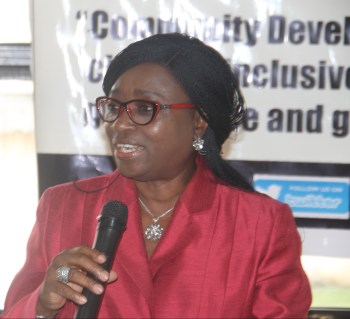
This was disclosed at a stakeholder’s forum on open access, organised by the Creative Commons, in partnership with the Nigerian Institute of Advance Legal Studies (NIALS). The programme, which focused on creative, common and access to content, brought together government agencies, members of the academia, lawyers, analysts, students, business owners, technological start-ups and social media experts.

Adekunle, who was represented by the Director of Studies at NIALS, Prof Anmi Awah, said although infrastructure development is key,

“we will not wait until we have a wide spectrum of infrastructure before we follow the rule guiding use of materials online which should be followed to the letter.”

 Consequently, Head of Regulatory Department of Nigerian Copyright Commission, Mr. Michael Akpan, said that the Federal Government will amend the Copyright Act to make it more digitally-compliant.

According to him, the country’s new copyright system, like similar regimes, reflects key fundamental policy thrust.

He said the system was designed “to strengthen the copyright regime in Nigeria, to enhance the competitiveness of its creative industries in a digital and knowledge-based global economy; to effectively protect the rights of authors to ensure just rewards and recognition for their intellectual efforts while also providing appropriate limitations and exceptions to guarantee access to creative works, encourage cultural interchange and advance public welfare.”

Akpan noted the new draft bill for the protection of intellectual properties in Nigeria expanded the scope of limitations and exceptions to make allowances for more free uses of creative works particularly in the context of educational and non commercial activities.

He stressed that the task of shaping copyright for the digital network environment should not be restricted to the legislative dimensions of copyright law, but must take into account, how copyright is managed in practice.

He added that the reforms of the copyright system should be beyond new legislative provisions and that, changes in policies, copyright culture and practice may in fact be more relevant than changes to the legislation.

He said that open access is important to the growth of the information society as information and knowledge has become the greatest building blocks for societal development.


“Nigeria is a developing country at the throes of maximizing its huge human and natural resources. One of the roads to achieving this is the platform provided by open access which provides free online access to information which anyone may require,” he said.

He added, “Nigeria is endowed with a population predominantly made of youths with undeniable creative capacities who can utilize this platform to gain knowledge and how that will eventually change the fortune of our country”.


Technical Lead, Creative Common Nigeria, Mr. Kayode Yusuf said that the forum is set to create awareness and support for open access among stakeholders in Nigeria.

“For a country in the process of reforming its copyright laws to align with current requirements of the digital age, the concept of ‘open’ cannot be ignored”, he noted, adding, “that it is clear that the philosophy of ‘openness’ in any form of knowledge governance is still a strange phenomenon in Nigeria. The level of awareness and scale of implementation of the different models of openness in knowledge governance in the country are insignificant in proportion to its size, needs and population.”

He said the concept of open access has a lot of potentials for Nigeria as it will open more access to data, information and education that are needed to galvanize development.

“We will continue to engage the various stakeholders and entrenched the merits of open in addition to the fact that it is in perfect alignment with digital technology as the principal means of knowledge production and dissemination today. The philosophy of ‘open’ in knowledge governance and its merits can be seen in both the public and private sectors in education, research, governance,” he said.

Safeguarding journalists rights, vital for sustaining democracy-Ubani

By Funmi Falobi & Tobi Oyetunde<

Nigerian journalists have been commended for roles played in the entrenchment of democracy in Nigeria even as the media is urged to do more in the area of enlightening the people.

Speaking at a recent roundtable of the Nigerian Journalists’ Safety Initiative on the theme, “Safeguarding Press Freedom and Safety of Journalists among Rising Conflict”, former Chairman, Nigeria Bar Association (NBA), Ikeja Branch, Monday Ubani said journalists have done so much but they still need to do more to educate the society.

In safeguarding press freedom and safety of journalists in the country, Ubani called on the Federal Government to enact modern and robust laws that will help safeguard journalists. He also urged the Nigeria Union of Journalists (NUJ) to ensure that there is adequate and strict compliance to journalism ethics by professionals in discharging their duties.

Ubani, who was represented by Barrister Evans Ufeli  at the event, organized by the International Press Centre (IPC) Lagos, with the support of Open Society Foundations (OSF), pointed out that the constitution of the federal republic of Nigeria does not sufficiently give room for press freedom. He noted that a strong freedom of the press,  ensures informed, active and engaged citizenry, and therefore called on journalists and media groups to work for the enforcement of Chapter 2 of the Constitution for them to be able to perform their function as the fourth realm of the estate.

DSC00038

“Strong freedom of press is essential to ensure the safety of journalist and eradicate impunity. Section 22 and 39 of the 1999 constitutions (as amended) guarantees freedom of expression but in spite of all these constitutional provisions, there is no clear indication of strong and special forms of protection for the press to carry out its constitutional obligations without interference, threat to life or extra-judicial repercussion”, he said.

“Section 45 of the same Nigeria constitution curbs the freedom given by Section 22 and 39. This kind of curtailment is abundantly manifested in Nigeria media environment with draconian legislations and decrees like the Sedition act.” He added.

P1050181.JPG

Lamenting the various attacks on journalists where some have been killed, he reiterated the importance of maintaining true press freedom in the country. “The special protection that strong freedom of the press should provide journalists and media workers should be holistic to include preventive, protective and pre-emptive measures.”

He therefore urged government to make the environment conducive and safe for journalists to discharge their duties of holding the government accountable to the people.

Mr. Tive Denedo, former Campaign Director of Media Rights Agenda and CEO of Sunfair Communications also decried continuous assaults of journalists and beckoned the pen pushers to position themselves to ensure Nigeria attain the state where there will be true press freedom in the country.

new.JPG

“No government official will offer you freedom, you must fight and take it forcefully. Journalists should not keep quite when under threat but must always open up on any threat they face from anybody as they go about discharging their duties”, he said.

How grassroot members can engender development via budget tracking and monitoring

-By ‘SANMI FALOBI & TOBI OYETUNDE

Community members from Lagos grassroot communities have been told that they can use budgetary provisions to engender development in their communities. This was the outcome from a 2-day budget literacy and monitoring training organized for leaders of community based groups from Boshoa, Orile Shomolu, Araromi Odo, Bashua and Bajulaiye areas in Shomolu local government, Lagos.

The two-day training which had experts on specific subject matter speaking to enlighten participants on what to know about engaging in budgeting process and monitoring the implementation of social provisioning targets in the budget at local and state levels was organized under the Strengthening Citizens in Electoral Processes (SCEEP) project being implemented in Lagos state by the International Press Centre (IPC) across six local government areas; Shomolu, Lagos Mainland, Surulere, Ifako Ijaiye, Ikorudu and Amuwon Odofin. The SCEEP project is with the support of Actionaid Nigeria and the UKAID/DFID.

According to the organizers, the broad objective of the training aims to broaden the knowledge of targeted community leaders/activists on the whole gamut of the budgeting process so that it can be used as an instrument of making government provide social facilities and development.

“Budgets can show if a government is pro-poor or pro-rich, based on what the budgeted money would be spent on which may have vary effects on different population groups. For example, a government that budgets more money for education, health care, roads, etc can be said to be pro-poor or pro-people”, Lanre Arogundade, Director, IPC stated.

“Budgets are factors in politics and political participation. The people have a right to be involved in the budgeting process, that is why overtime, trade unions, businesses, industries, civil society groups and other interest groups have always sought to be involved in the process and that is why this budget literacy training is being designed in such a way that community representatives can be in a position to make inputs into the budget of our local government or the state, and also be able to follow up the implementation, through monitoring and tracking”, he added.

“In summary, we want to be budget literate, to be a budget tracker and to be a budget monitor so that we can hold our government and leaders accountable and ensure good governance, by making sure that governments do what it says it would do in the budget, which is what accountability and transparency is all about”, he charged.

Taking participants through the rudiments of the budgeting process, Lere Oyeniyi from the Institute for Media and Society shared perspectives on the key concepts in budgeting and features/characteristics of a good budget, how to prepare budget using case studies of household budget, organizational budgeting and government budgeting processes, understanding the functions of budget as a tool for control, management, planning and social provisioning and the process in developing simple budgets to draw lessons on the inter-relation between allocation and utilization of resources in social provisioning, amongst others.

P1020049.JPG

“Budgeting takes place in a human environment and it affects people’s behavior, depending on a number of factors such as: the way budget was drawn up, involvement in preparation or lack of it, manner of communication, education and training and the manner of implementation” he said. “A good budget should be motivating, challenging, based on Realistic Assumptions, prepared bottoms-Up & not Top Down, be detailed, measurable and assignable, be practical to implement, be attainable and be reviewable in the light of changing circumstances or reality”, he added.

In his own presentation, Micheal Awopetu from the Centre for Ethics and Cultural Orientation took participants through understanding the importance of budgets and how budgets are used in the planning of government administration including highlighting the different stakeholders in the budgeting process, with emphasis on how citizens can engage with the budget processes, viz-a-viz the key entry points for citizen’s engagement, as well as the concept of participatory budgeting, shared good practices from a rights-based approach for community engagement with all stages of the budget process.

P1020064.JPG

“We should engage the budget at different levels and not just stay aside as if it does not concern you. When you speak out, your representatives can take your issues further, but when you don’t, they spend the money the way they like on your behalf” he said. “You can use the annual report by respective ministries to look at what is allocated to your community and how the budget affects you. Engagement with relevant officials and your representatives, lobbying, community participation through counter funding and physical inspection and monitoring of the stages of ongoing projects are tools that you should use to ensure that your community is not left out. You should not just rely on your representatives only, their personal aides and legislative assistants as well as other officers or appointees in government can be very instrumental in changing things” he added, amongst others.

According to Stanley Achonu, Senior Manager Projects of BUDGIT, there is a great need for citizens to engage the budgeting process to ensure effective execution.

He said, “you have to be involved in budget planning because it makes you participate in how government and tax payers money are being spent in a way that it will be beneficial to you. You have to stop complaining because complaining doesn’t solve any problem rather you should start acting and the action should be a peaceful and engaging one. The budget of a country is a law and it’s our duty as citizens of a country to inquire from our legislators to know what is allocated for our communities inside the budget.”

In addition, he made the people know that budget participation is a continuous process starting from budget planning to completion of the project.

P1020131.JPG

“Budget involvement is a continuous thing, you start by engaging the Councilors and legislative members representing your constituency. Create and maintain a working relationship with your representatives, because they are the ones representing your interest both at the state and federal level. List your community needs in order of priority and present it to those representing you. Hold regular meetings with these people especially your counselors and these meetings should be peaceful and void of fight and riots.”

Participants at the training lauded the organizers in bringing the training to the grassroots,as it is a form of exposure and making the people know their right and how to be involved in budget process.

According to Peter Uche, a participants from Bajulaye: “the training is a very good one as it expose us to how to analyze and trace government budget. It also opened our eyes to knowing what to do as citizens when it comes to budget and also helps in enlightening other members of the community”.

Another participant,  Toyin Badmus from Orile Shomolu, urged other participants in the training to always speak out whenever they are in need of anything from the government and they should channel their actions in the right way that the government will know they need certain infrastructures in their communities.

Media, CSOs partner to report abandoned corruption cases

– By Funmi Falobi –

As Nigeria intensifies the fight against corruption, a select of media professionals and civil Society Organizations (CSO) across Nigeria are partnering to bring to limelight, abandoned and hibernating high profile corruption cases under an initiative entitled,   “Reporting Until Something Happens (RUSH)”.  The  initiative which recently commenced with a 3-day CSO/Media case tracking and judicial performance oversight workshop in Enugu aims to increase reporting on hibernating high profile corruption cases  in order to engender public demand for speedy completion and as well get the government to prioritizing the cases in its anti-corruption agenda.

Speaking at the workshop organized by the Department for International Development (DFID) and supported by the British Council,  Emmanuel Uche, Anti Corruption Programme Manager, Justice for All (J4A) said that since the inception of the Economic and Financial Crime Commission (EFCC), only eight high profile cases have so far been convicted, adding that out of the eight,  one was upturned by the court making it only seven convicted, thus there is the is need to bring to the front burner these cases that are either hibernating or gone to sleep in the country.

“Most of the cases with the EFCC are either been stopped, hibernated or swept under the carpet. This can only be so on sheer impunity”, he said. He noted that there is need to empower the media and civil society organizations to take up high profile corruption cases as well as for the judiciary to be up and doing.emmanuel

“For the anti- corruption campaign to be successful, the judiciary must demonstrate independence, impartiality, integrity, accountability and transparency to sustain the rule of law.

“Judiciary is arbiter of not only democracy but political, social and economic development. Nobody will come to the economy where there is no rule of law, respect for rights. For there to be government of the people, by the people and for the people, there must be a rule of law in place, if not, forget political development”, he added.

According to him: “Judicial systems need to provide timely access to fair and impartial judicial services and uphold the rule of law consistently.”

emekaSimilarly, Emeka Ononamadu, Executive Director, Citizens Center for Integrated Development and Social Rights (CCIDESOR) called for synergy between the media and the CSO in the fight against corruption in the nation.

walterAlso speaking, Dr. Walter Duru, Executive Director, Media Initiative against Injustice, Violence and Corruption (MIIVOC) urged the media to sustain reportage of corruption and humanize effect of corruption in the society in order to engage citizens in the fight against corruption.


Education grant: 20 students get Gani Fawehinmi scholarship

– By Tobi Oyetunde –

It was pleasant moments for 20 Students across Nigeria universities who received the 2016 Annual Gani Fawehinmi Scholarship.

The lucky students who receive the 2016 awards of a cash prize of 100,000 naira each include: Ajewole Thomas Adeyemi (University of Ibadan), Akinsanya Damilola John (University of Ibadan), Akorede Adelupe IIiyas (University of Lagos), Ariyibi Ahmod Babatunde (Bayero University, Kano), Ashiru Fatai Aderoju (Federal University of Agriculture, Abeokuta), Ephraim Jeremiah (Abubakar Tafawa Balewa University, Bauchi). Others are Eyam Rita Esighetti (University of Calabar), Folorunsho Abidemi Bashiru (Federal University of Agriculture, Abeokuta), Goji Joy (Ahmadu Bello University, Zaria), Kalu Kinsley Samuel (University of Calabar), Michael Faith Eloho (University of Calabar), Moshood Yusuf Lere (University of Ibadan), Okezie Nina Chidinma (Michael Okpara University), Okorie Uchechukwu Victor (University of Lagos), Olofinnika James Adewole (Obafemi Awolowo University).

The annual awards, which began in 1973, and has served as source of empowerment to over 800 students since inception was also used to celebrate and remember the legacy of Late Gani Fawehinmi. The event was celebrated with the theme, ‘Education in the Age of Neoliberalism: Local and External Contexts’.

gani-schorlaship-jpg2

Speaking at the event, Mr. Oladipo Fashina, Chairman of the Gani Fawehinmi Scholarship awards Board reiterated that the principle of late Chief Gani Fawehinmi must not be forgotten. While addressing the university students present, Mr. Oladipo advised them to be sincere and put more energy into their education.

He said, “we must never forget the principle of Gani and what he lived for. We must follow his legacy in improving the education sector of the country in any capacity we can. Education is a right which must be exercised by all Nigerians with real equality of opportunity, such right must be to a free education, free education is capable is capable of ensuring political stability and every Nigeria youth must e educated so that he may be free to live a dignified and useful life.”

The guest speaker at the ceremony, Dr. Sylvester Odion Akhaine, Senior Lecturer in the Department of Political Science, Lagos State University lamented how policy made by government is killing education and encourage everybody to fight for their right.

“The fact that politicians now showcase red roofs in primary and secondary schools is an indication of the decay in that sector during the adjustment years. The short of it is that the structural advancement policy has endangered unprecedented levels of peonage in Nigeria’s history, economic underdevelopment”, he noted.

He concluded by saying, “we must rescue the educational sector from its present paralysis, free it from policy summersault, underfunding and the spasm of massification underlined by the illusion of choice and banking approach based on memorization.”

gani-schorlaship-jpg2-jpg3

Towards 2019: Stakeholders task Buhari on credible elections

– By ‘SANMI FALOBI-

Against the backdrop of the old adage that, ‘he who fails to plan, plans to fail’, stakeholders have tasked the Buhari administration to show more commitments in consolidating the gains of the 2015 elections by ensuring that the Independent National Electoral Commission (INEC) is properly constituted and given the enabling operational requisites to be able to conduct credible elections, especially ahead the 2019 general elections.

According to the stakeholders, beyond the present administration’s overt commitment to fighting corruption, the administration should also be equally committed to ensuring that the democratic processes are transparent and credible, in order to entrench the gains on the credibility and transparency demonstrated by INEC in the 2015 elections.

Sharing perspectives as panelists in a national town hall meeting in Abuja, civil society stakeholders, opinion leaders and other key electoral stakeholders were of the opinion that more needs to be done if INEC is to be able to deliver credible elections come 2019.

In her opening remarks, Ojobo Atuluku, the Country Director of Actionaid, organizers of the event, said the town hall meeting which was also used to publicly present the outcome of a 2015 post election survey report conducted by Actionaid under its Strengthening Citizens Engagement in Electoral Processes (SCEEP) project, was to create an opportunity to connect the people, citizen groups and policy makers to dissect issues to deepen the gains of the 2015 elections as well as on steps to conducting more credible elections in the future.

IMG_20160831_124144

Speaking on the central theme, ‘Making the electoral process citizens-centred: Deepening the gains of the 2015 elections’, former Chairman, National Human Rights Commission, NHRC, Chidi Odinkalu, said that elections may not hold in 2019 as there may be crisis and death if there are no adequate preparations to ensure that the elections are credible.

Today, the executive has gone into lax mode; judiciary has become lawless; National Assembly is lacking in credibility; INEC is troubled; politicians have gone unruly. Government says it has no money to run the economy. Every element that made 2015 is currently missing,” he said.

According to him, it was worrisome that key portfolios of personnel and designations in INEC have been left vacant.  “There is absolutely no reason why the executive should allow the number of vacancies we have in INEC to be.”

“INEC is having a challenge. By next month, INEC will be having 28 vacancies among its RECs (Resident Electoral Commissioners) and seven commissioners. The Executive is carrying on as if this normal. It isn’t”, he added.

According to him, “continuing the way we are going, we will not be able to have elections in 2019. If it happens, there would be too many broken heads and dead people.”

In a related contribution, Clement Nwankwo, Executive Director, Policy and Legal Advocacy Center (PLAC) and Convener, Civil Society Situation room noted that all hands must be on deck to build on the gains of the successes of the 2015 elections. According to him, the civil society must continue to do the work they can to ensure that the democratic governance is deepened, adding that the country is presently in a national emergency as the  electoral body does not have the full complement of electoral commissioners needed for the  general elections.

Nigeria is in an emergency situation. In less than two and half years to the 2019 elections, INEC does not have the full complement of electoral commissioners. The question then is why is the delay? … If we continue this way, we shall lose our democracy. So we must act. If those in government do not act with urgency, we will lose this democracy“, he declared.

Similarly, other perspectives were given by stakeholders which included representatives of other civil society groups, namely; Ekaette Umoh, National President, Joint National Association of Persons with Disabilities (JONAPWD) Abiodun Ajijola of Election Monitor, Ezenwa Nwangwu of Partners for Electoral Reform and Samson Itodo, Head Research Policy and Advocacy, YIAGA, who spoke as an advocate of the #NotTooYoungToRun campaign.

While calling for collaboration of all stakeholders, Amina Zakari, INEC National Commissioner in charge of election operations, noted that the attaining credible elections involves all.

In 2015, for the first time, Nigerians believed they could effect a change in our political system. There was also dedication in the part of INEC, Security agencies and civil societies who spoke in one voice”, she said.

Democracy and elections is for all and by all; everyone, not just INEC or politicians”, she added.

In the same light, the Chair, Senate Committee on INEC, Abubakar Kyari who agreed that democracy was about the people told the gathering that the Senate was working to ensure that the electoral laws are amended to ensure credible elections.

We have sought for suggestions from the general public in order to fashion out an amendment in the electoral system. Our plan is to get our electoral reforms ready before December and have the president sign it into law”, he said.

IMG_20160831_124301.jpg

Connect with government on grassroot development, Lagosians urged

By Funmi Falobi-

Lagos residents have been urged to be involved in government activities in order to bring development to their communities.

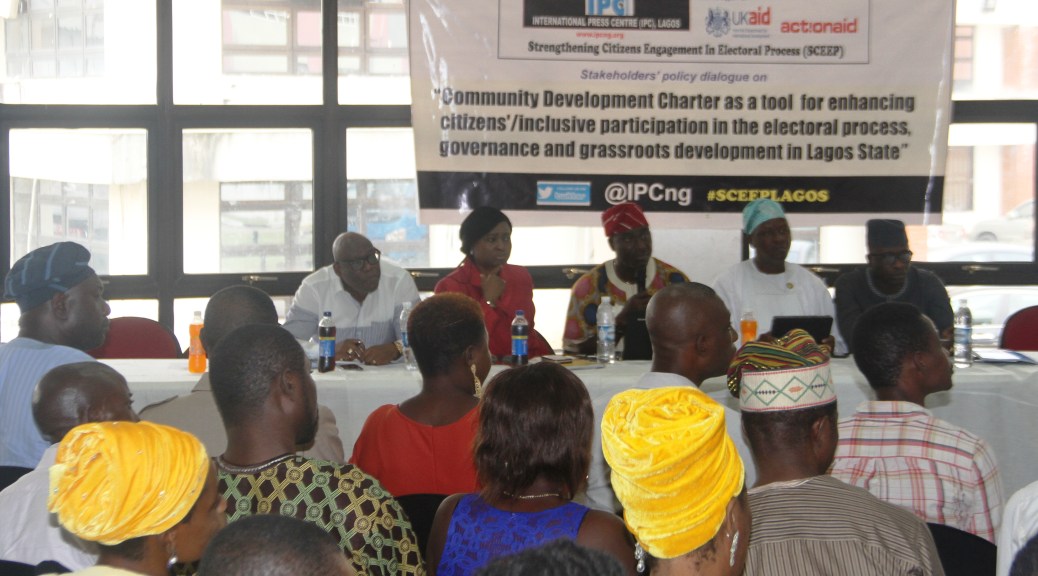
This was disclosed at the public presentation of Community Development charter for three communities; Obele Oniwala, Isokan, and Aiyetoro communities in Surulere local government area of Lagos State. The programme was organised by the International Press Centre (IPC) with support of UKAID and ActionAid Nigeria.

Speaking on the topic entitled “Enhancing Grassroots Development: Bridging the Gaps Between Government and Community Stakeholders” Abiodun Aremu, rights activist and Secretary General, Joint Action Forum (JAF) said people must be interested in what is happening around them for development to take place in their communities.

“Development must start with self. You must have interest in what is happening for development to take place in your communities”, he said.

He called on the grassroot community stakeholders to appreciate the enormous constitutional power they have and that they can use that to make government develop the grassroot communities.  According to him: “Development works when it is for all of us. Our community’s values have broken down so we have to get them back”.

He noted that it takes community effort to get development at the grass root. “As grassroots people, we must first recover our values. Anything we want, we must get it from Government and they are not doing us any favour”.

He urged the government to always consult with community members before implementing its policies. “Every development and policies must come from the people and that is how people living in communities can be further empowered to drive development”. He said.

“The poor man has one vote, the rich man has one vote, if the vote is equal, development should be equal” he added.

Similarly, the Chairman of Community Development Association in Surulere Local Government, Abayomi Balogun, corroborated that there can never be democracy without grassroots participation and development.

“Grassroots development is very important and that is why the local government election coming is our election. The state and the federal elections in the country are not our elections; the local government election is our election because that is the tier of government that collects all sorts of levies and taxes from us, so we must be involved,” he said.

DSC00027

Celebrating Funke Egbemode as NGE President

-By FUNMI FALOBI-

Female journalists in Nigeria do have reasons to hold up their head in high esteem following the recent election of Mrs. Funke Egbemode as the substantive president of the Nigerian Guild of Editors (NGE) at the guild’s 12th annual conference in Port Harcourt

Egbemode, who is the Managing Director and Editor-in-Chief, New Telegraph Newspaper, becomes the second female journalist after late Mrs. Remi Oyo who was president of the guild between1999 and 2003.

Speaking on her confirmation, the astute journalist who in July was nominated president in acting capacity declared: “For the time I will be in the saddle, the guild will change for the better, will become more visible.”

Expressing her gratitude, she said, “I feel honoured and I feel like that I have just been handed a big responsibility, like a big board that must not drop. I urge members to keep the flag flying. We have done very well as a body. We should continue to do things that will elevate the Guild, whatever will promote journalism, whatever that will promote the body.”

Those who are familiar with her, describe her as a seasoned journalist who has worked in different media houses at the top management level. Egbemode started her career as a staff writer in the defunct Prime People magazine. She moved to The Punch in 1993 where she rose to become the Deputy Features Editor. In 2000, she was appointed Editor of The Post Express on Saturday. She was also the pioneer Saturday Editor, Independent Newspaper; Sunday Editor, The Sun Newspaper and later General Editor of the newspapers, a position she held until her appointment as Managing Director/Editor-in-Chief of the New Telegraph Newspapers in 2015. She had also served as the Special Adviser (Media) to the former Speaker, House of Representatives, Patricia Olubunmi Etteh.

Born in Ijabe, Osun State, Egbemode attended Baptist Practising Primary School, Iwo and Baptist Girls High School, Osogbo. She holds a Bachelor of Arts degree from the Obafemi Awolowo University, Ile Ife. She also holds a Post-Graduate Diploma in Journalism from the Nigeria Institute of Journalism, Lagos.

In a congratulatory message, the Governor of Lagos State, Mr. Akinwunmi Ambode described her emergence as an inspiration to other women.  “I have no doubt in my mind that the cap fits Mrs. Egbemode. She has a proven track record of excellence in journalism, which has seen her rise through the ranks to the pinnacle of the profession”, the Governor said.   “I urge Mrs. Egbemode to see her new assignment as one that comes at a time in our national life where we need the media to be more circumspect and developmental in playing its role as the watchdog of the society,” he added.

The Senate President, Dr. Abubakar Bukola Saraki, described her emergence as “a square peg in a square hole”. He noted, “Mrs. Egbemode is not just a technocrat and media executive of repute, she is a professional par excellence. She is a living example of the saying that ‘what men can do, women can do better.”

The Ogun State Governor, Senator Ibikunle Amosun described her emergence as “a well deserved honour.” He noted: “Anyone who has followed the career path of Egbemode over the years will not be surprised at how far she has come in her chosen profession of journalism.”

… … Enhancing sustainable socio-economic development issues