Connect with government on grassroot development, Lagosians urged

By Funmi Falobi-

Lagos residents have been urged to be involved in government activities in order to bring development to their communities.

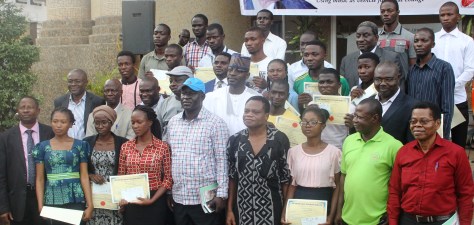
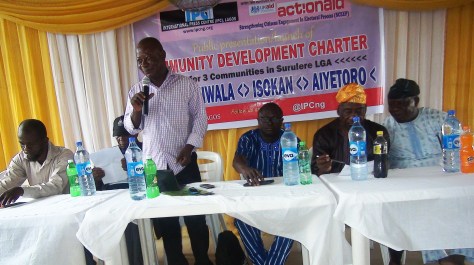
This was disclosed at the public presentation of Community Development charter for three communities; Obele Oniwala, Isokan, and Aiyetoro communities in Surulere local government area of Lagos State. The programme was organised by the International Press Centre (IPC) with support of UKAID and ActionAid Nigeria.

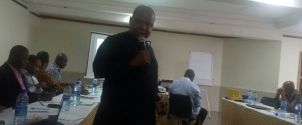
Speaking on the topic entitled “Enhancing Grassroots Development: Bridging the Gaps Between Government and Community Stakeholders” Abiodun Aremu, rights activist and Secretary General, Joint Action Forum (JAF) said people must be interested in what is happening around them for development to take place in their communities.

“Development must start with self. You must have interest in what is happening for development to take place in your communities”, he said.

He called on the grassroot community stakeholders to appreciate the enormous constitutional power they have and that they can use that to make government develop the grassroot communities.  According to him: “Development works when it is for all of us. Our community’s values have broken down so we have to get them back”.

He noted that it takes community effort to get development at the grass root. “As grassroots people, we must first recover our values. Anything we want, we must get it from Government and they are not doing us any favour”.

He urged the government to always consult with community members before implementing its policies. “Every development and policies must come from the people and that is how people living in communities can be further empowered to drive development”. He said.

“The poor man has one vote, the rich man has one vote, if the vote is equal, development should be equal” he added.

Similarly, the Chairman of Community Development Association in Surulere Local Government, Abayomi Balogun, corroborated that there can never be democracy without grassroots participation and development.

“Grassroots development is very important and that is why the local government election coming is our election. The state and the federal elections in the country are not our elections; the local government election is our election because that is the tier of government that collects all sorts of levies and taxes from us, so we must be involved,” he said.

DSC00027

Celebrating Funke Egbemode as NGE President

-By FUNMI FALOBI-

Female journalists in Nigeria do have reasons to hold up their head in high esteem following the recent election of Mrs. Funke Egbemode as the substantive president of the Nigerian Guild of Editors (NGE) at the guild’s 12th annual conference in Port Harcourt

Egbemode, who is the Managing Director and Editor-in-Chief, New Telegraph Newspaper, becomes the second female journalist after late Mrs. Remi Oyo who was president of the guild between1999 and 2003.

Speaking on her confirmation, the astute journalist who in July was nominated president in acting capacity declared: “For the time I will be in the saddle, the guild will change for the better, will become more visible.”

Expressing her gratitude, she said, “I feel honoured and I feel like that I have just been handed a big responsibility, like a big board that must not drop. I urge members to keep the flag flying. We have done very well as a body. We should continue to do things that will elevate the Guild, whatever will promote journalism, whatever that will promote the body.”

Those who are familiar with her, describe her as a seasoned journalist who has worked in different media houses at the top management level. Egbemode started her career as a staff writer in the defunct Prime People magazine. She moved to The Punch in 1993 where she rose to become the Deputy Features Editor. In 2000, she was appointed Editor of The Post Express on Saturday. She was also the pioneer Saturday Editor, Independent Newspaper; Sunday Editor, The Sun Newspaper and later General Editor of the newspapers, a position she held until her appointment as Managing Director/Editor-in-Chief of the New Telegraph Newspapers in 2015. She had also served as the Special Adviser (Media) to the former Speaker, House of Representatives, Patricia Olubunmi Etteh.

Born in Ijabe, Osun State, Egbemode attended Baptist Practising Primary School, Iwo and Baptist Girls High School, Osogbo. She holds a Bachelor of Arts degree from the Obafemi Awolowo University, Ile Ife. She also holds a Post-Graduate Diploma in Journalism from the Nigeria Institute of Journalism, Lagos.

In a congratulatory message, the Governor of Lagos State, Mr. Akinwunmi Ambode described her emergence as an inspiration to other women.  “I have no doubt in my mind that the cap fits Mrs. Egbemode. She has a proven track record of excellence in journalism, which has seen her rise through the ranks to the pinnacle of the profession”, the Governor said.   “I urge Mrs. Egbemode to see her new assignment as one that comes at a time in our national life where we need the media to be more circumspect and developmental in playing its role as the watchdog of the society,” he added.

The Senate President, Dr. Abubakar Bukola Saraki, described her emergence as “a square peg in a square hole”. He noted, “Mrs. Egbemode is not just a technocrat and media executive of repute, she is a professional par excellence. She is a living example of the saying that ‘what men can do, women can do better.”

The Ogun State Governor, Senator Ibikunle Amosun described her emergence as “a well deserved honour.” He noted: “Anyone who has followed the career path of Egbemode over the years will not be surprised at how far she has come in her chosen profession of journalism.”

Hope rises for IDPs as U.S. provides assistance to Lake Chad Basin Region

> By FUNMI FALOBI<


Reprieve is in the offing for over five million Internally Displaced Persons (IDPs) as the United States government, through its Agency for International Development (USAID) on Wednesday announced that it will provide more than $37 million in additional humanitarian assistance to people affected by the ongoing conflict and severe food insecurity in Nigeria and throughout the Lake Chad Basin.

The new funding to United Nations and Non-Governmental Organisation (NGO) partners will help tens of thousands of people receive critically needed humanitarian assistance, including food, water, shelter, and services to address acute hygiene, protection, and nutritional needs following the savagery of Boko Haram which has triggered a humanitarian crisis in Nigeria and surrounding countries in the Lake Chad Basin region.. Despite gradually improving security conditions, the humanitarian situation remains dire as families have been driven from their homes, millions are left without enough to eat, and human rights abuses are widespread. Throughout the region, approximately five million people need emergency food assistance, and 2.5 million people are displaced.

Three senior USAID officials—Nigeria Mission Director Michael Harvey, U.S. Office of Foreign Disaster Assistance Director Jeremy Konyndyk and Office of Food for Peace Deputy Director Matt Nims—made the announcement following a trip to the country’s northeast, where the humanitarian needs are the most acute. With this announcement, the United States is providing more than $318 million in humanitarian assistance since FY 2015 to the Lake Chad Basin region and continues to be the single largest humanitarian donor to the region. The food assistance will be delivered to conflict-affected communities in the Diffa Region of Niger, including populations who fled their homes following the recent attacks in Bosso. This new food assistance will be coordinated with the humanitarian community in Nigeria to scale up the overall regional food response.

In addition to humanitarian funding, USAID provides targeted assistance that seeks to reduce extreme poverty and improve the quality of life for Nigeria’s most vulnerable communities through improved governance and civic participation at the federal, state, and local levels; reduced corruption; a strengthened private sector as a source of job creation; and improved quality of social service delivery.


Photo L-R: NEMA DG Muhammed Sani Sidi and USAID Director of Foreign Disaster Assistance, Jeremy Konyndyk.

… When JOINvalue extended heart of love to Modupe Cole Memorial Home

>By Tobi Oyetunde<

Impacting lives positively, the motto of JOINValue (Jewels of Inestimable Values), a non-governmental organization came to the fore on Sunday, 3rd of July, 2016, when the founder, Miss Chichi Ogbonnaya and her team members showered love to the children of Modupe Cole Memorial Child Care and Treatment Home, Yaba, Lagos.

The visit to the home which also included donation of food items was done in celebration of Miss Chichi Ogbonnaya’s birthday as a demonstration of her passion to reaching out to the less privilege.

pix.chichi

According to her, it is better to give than to receive, especially to the less privilege.

“I know how it feels to be in a state of need as I have been there before but it is only Jesus and His grace that made me who I am today. So I prefer to give than to receive because when you give to others, God will continually bless you.” she said.


“I feel this burden in my heart to give to those who are not privileged to have what others have and that is what brought about the existence of the organization, JOINValue”, she added.

Receiving the team, a teacher in the house, Mr. Kareem welcomed the gestures of the JOINValue team to the house.


He said: “there are three types of people in the house; the educable, the trainable and the totally dependant”. Speaking further, he said: “the educable are those who have the ability to learn regardless of the fact that they are slow learners because they can not comprehend like a normal person due to their mental and psychological makeup. The trainable are those who are not educable but can be trained to learn handwork and skills, while the totally dependant are those who can not do anything on their own, can not read and write, can not learn skills and can not even eat; they have to depend on the care givers in the home.


Kareem explained that the Modupe Cole Home, which has been in existence for years is a haven for many children who have disabilities. “There are many people in the foundation who have disabilities, not only children but we also have a man of 64 years who happens to be oldest the home has accommodated”, he explained.


He noted that the inmates have challenges. “The students are slow learners and their retention is low as they forget what they are taught easily; they also go through crisis and sometimes they attack visitors when going through this crisis. Another thing is that there is not enough encouragement from the government.”


He noted that the government pays the teachers the same rate they pay normal school teachers whereas they do more work than normal school teachers. “While others work Monday to Friday, we work everyday, including weekends and public holidays”, he said.


He also lamented that parents do neglect their children in the home.

“Some parents do not want people to know they that have children that are disabled here as they see it as a thing of shame which is not suppose to be so. The government should help in changing the mentality of the people towards the disabled”, he said.


In showing love to the children, the JOINvalue team spent some time praying with the  children, shared some gifts with them and took photographs with them as a way of making them feel loved and have a sense of belonging in the society.

pix2

Grassroot development: Ikorodu communities gets Community Development Charter

>By Tobi Oyetunde<


“Grassroots development remains a cardinal component of global campaigns of the 21st Century. It is therefore important that the community as the epicentre of human and environmental activities should remain a recurrent decimal in the narrative of developmental agenda”.


This statement by Mr. Francis Abayomi, Executive Director, Peace and development Projects (PEDEP), aptly captures the essence of community led initiatives being implemented in Lagos by the International Press Centre (IPC) with the support of ACTIONAID Nigeria and the DFID/UKAID under a project entitled “Strengthening Citizens Engagement in Electoral Processes (SCEEP).


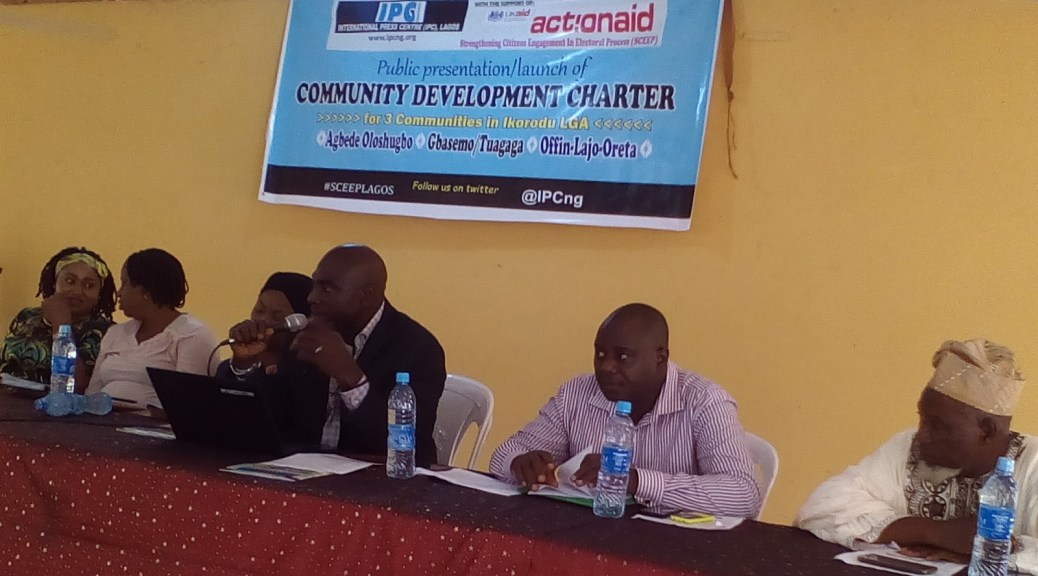
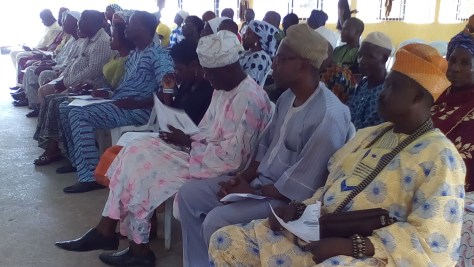
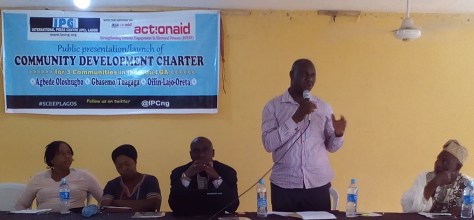
Speaking on the topic: “Community Interest vs Political Interest: Perspectives on Enhancing Grassroots Development” at the public presentation of Community Development Charters for three communities in Ikorodu Local Governement area of Lagos, namely: Agbede-Oloshugbo, Gbasemo/Ituagaga and Offin-Lajo-Oreta Communities respectively, Abayomi charged community leaders at the grass root not to insulate themselves against politics as stakeholders in community development as well as political actors are expected to work hand-in-hand rather than at cross-purposes in ensuring that the community remains on the path of steady development without negative consequences of political divisions.


IMG_20160616_125649

According to him, “a systematic approach” that creates an increased understanding and cooperation among the people and between the people and the government should be employed in advancing the development at the grassroots because development process is not unidirectional as there is need for access to information, improvement in communication and enhancement of peaceful change and sustainability of developmental initiatives.

“When the community is organized for developmental process, participation should be based on the principle of consensus building which involves dialogue, negotiation, and meditation. Everyone must be included in decision making process while transparency, openness and accountability must be encouraged through the use of a proper feedback mechanism”, he said.

IMG_20160616_130931

He however maintained that political interest of community stakeholders should not override their community interest. He said: “politics should be played in a way that it will not affect the needs of your community. As a stakeholder in the community, you must play politics with maturity in the sense that you should not place your personal and selfish needs above what will benefit the society at large”.

In fast tracking the development of the communities, he urged community stakeholders to interact and engage with duty bearers on their community development aspirations.

“The people must play the role of assessing projects, prioritizing projects, building strong teams to pursue common goals, identify key partners outside the community and build leadership capacity. As a community member, you must work for the growth of the community and make this charter which is the needs of your community known to everybody and the government”, he said.


IMG_20160616_124708

Sequel to Abayomi’s discourse, the community development charters for the three communities was then official presented to the public by the Director of IPC, Mr. Lanre Arogundade with copies received by the Senior Admin. Officer, Mrs. Olatunji Adeoye who was representing the newly appointed Sole Administrator of Ikorodu Local Government Area, amongst a host other officials from the local government. Copies of the charter were also handed over to community leaders and related community stakeholders at the event.

IPC/ACTIONAID launches community development charter in Lagos

>By Funmi Falobi and Tobi Oyetunde<

IMG-20160608-WA0049

As part of efforts to ensure community driven development at the grassroots, the International Press Centre (IPC), has launched community development charters for Lagos communities. The charter, otherwise called village book, captures the community profile and summary of development aspirations of grassroot communities following series of community led engagements facilitated by IPC in 18 communities across six local government areas of Lagos State with the support of Actionaid Nigeria and the Department for International Development DFID/UKaid, under a democratic governance initiative tagged: Strengthening Citizens Engagement in Electoral Process (SCEEP).

Speaking at the public presentation of the charters to the first set of three communities in Lagos, namely, Erejuwa-Makoko, Otumara-Ilaje and Isale-Iwaya in Lagos Mainland Local Government, the Director of IPC, Mr. Lanre Arogundade noted that there was the need for the media to do more in community reporting to aid grassroot development.

“The media doesn’t really cover the grassroots citizens and what happen there. So there is a need to change the orientation of journalists. They should not only report campaign before election but do follow up after the election. This is called solution driven rural community reporting”.

IMG_20160608_140115

Highlighting the importance of the charter, Vanessa Edhebru, representing Actionaid said that the charter is to see that the excluded people stand a chance to partake in development process and that’s why the reflective methodology action was used to get the voice and wish of the people. She declared that the charter “will help to avert violence in the act of getting recognition and also give the people room to represent themselves in a way that the government will know that they know what they are doing.”


In his keynote address entitled “Enhancing Grassroots Development, Integrating Community Stakeholder in Governance” Mr. Adeola Soetan, National Coordinator, Democracy Vanguard enjoined the people to be participatory active citizenry by being sensitive to how they are governed and be pro-active by participating in government.

He implored community members to know what is right for them and be more conversant with their grassroots government. He explained that since various communities in their varied forms and formats constitute the building blocks of local government, the local government as the nearest to the people becomes the most important tier of government.

“Democracy without grassroots development is like tea without sugar or honey. Community should be the basic unit of development by virtue of the fact that this is where the overwhelming majority of the people, especially the poor and vulnerable who mostly need the basic essentials of life are”, he said.

According to him, it is better for people to know what they want than what the government thinks they want.

“Democracy should be like a pyramid that starts from the grassroots. People should be more concerned with what is happening in their communities than focusing on the federal.

“People should always put pressure on the government and themselves by monitoring budgets and projects, have a balanced agenda and ensure that everybody is involved in government. They should hold regular meetings with elected/appointed representatives to assess performance, evaluate feedback for effective information dissemination and useful communication management between government and the governed,” he said.


Receiving copies of the charter, the Executive Secretary of Lagos Mainland, Mrs. Essien Rashidah Omolola stated thus; “these papers and lists of what the people want will surely get to our leaders. Everybody should join hands and work hard to build and develop the communities.”

IMG_20160608_140339

Senior Special Assistant to the Governor of Lagos State on Community Development Affairs and State Chairman, Lagos State Community Development Advisory Committee, Alhaji. Tajudeen Quadri noted that Lagosians have demonstrated yearning for basic amenities and not money, adding that it was the desire of government to meet the needs of the people.

“This present government is community driven, hence, the people should say whatever they want and the government will do it for them”, he said as he urged community members to also put in place measures to supervise the maintenance of newly constructed projects.


Commending the initiative, participants urged government at the local level to look into their needs in order to speed up development in their respective communities. Commenting on the development needs of the grassroot communities, the Baale of Otumara, Chief Kehinde Kalejaiye stressed the need for a health centre in Otumara community. He said: “as big as Otumara is, there is no health centre and we need a health centre in Otumara.”

IMG_20160608_140716   IMG_20160608_140843   IMG_20160608_140754

FOI advocates urge World Bank to reverse downgrade of information access

By FUNMI FALOBI.

Freedom of Information (FOI) advocates in Africa, supported by their counterparts around the world, are asking for a reversal of the decision by the World Bank to downgrade its access to information programme.

In a letter by the Working Group of the African Platform on Access to Information (APAI) to the World Bank’s President, Dr. Jim Yong Kim, endorsed by over 130 other national, regional and international organisations in Africa and other parts of the world, the FOI advocates noted that “both the decision itself and the diminished capacity of the Bank to engage on this critically important issue will send the unfortunate message to governments of developing countries around the world that the issue of transparency and, in particular, access to information, is no longer important or a donor priority.”


The Chair of the APAI Working Group, Ms Gabriella Razzano, said in a statement that the letter to the World Bank was only the first step in a series of measures planned by the advocates to get the World Bank to reconsider the decision.


It will be recalled that the World Bank recently closed its Governance and Inclusive Institutions (GII) unit and some of GII positions were transferred to other areas of the Bank. In the process, the Bank’s freedom of information-related work was also eliminated ostensibly because of a desire by the bank to increase traditional project lending.


Calling on the Bank to reconsider the decision, the FOI advocates noted that the World Bank, through its Access to Information Programme, has “played a key role in the passage and implementation of access to information laws around the world,” adding that “in Africa, where the process was slow, the active support of the World Bank to governments and civil society organisations has resulted in the fast tracking of adoption of access to information laws from five countries in the 2010 to 18 in 2016.”


They contended that the closure of the World Bank’s Access to Information Programme will not only hinder adoption and implementation of access to information laws but could also engender a reversal of the progress already made.


The organisations also observed that in support of the Sustainable Development Goals (SDGs), the Bank and other development agencies will be providing developing countries with loans and grants, arguing that “the need for citizens to access information on development financing and locally generated revenue is vital for the attainment of the SDGs” and that the bank’s decision also sends a negative signal in this area.


According to them, “in the absence of access to information and participation in programmes funded by governments and development partners, including the World Bank, the levels of corruption in Africa and other developing countries will undoubtedly escalate.”


Urging the World Bank not to abandon citizens at this time, the organisations argued that by accessing public information and monitoring development projects, citizens are able to hold governments accountable and to contribute to the realisation of development outcomes, adding that such efforts require the support of the World Bank’s technical expertise and influence to create maximum impact.


The organisations reminded the bank that over the past few years, multilateral institutions have moved towards being more inclusive of citizens in governance through initiatives like the SDGs, Global Partnership for Social Accountability (GPSA), Open Government Partnership (OGP) and Open Contracting, African Union Agenda 2063,among others, and that through various consultations, civil society organisations and citizens have contributed to the formulation and shaping of the character of these initiatives.


They insisted that the “World Bank’s role in standard setting on key transparency and integrity initiatives in development programmes has been unparalleled” and that at a time when discussions on SDG indicators on access to information as set out in Goal 16 target 10 are high on the global agenda, the bank’s leadership and expertise is needed.


The organisations told the Bank’s President that “the fight against poverty is about people. This fight cannot be won without people being able to access information. We strongly recommend that, rather than downgrading the Access to Information Unit, the World Bank should strengthen it so as to be able to continue the important work that the World Bank has been doing in this area.”


Diligence vs luck: Forum x-rays imperatives for attaining success

>By Tobi Oyetunde<


Which is most desirable; working towards a goal with diligence or hoping on luck to be successful? That was the focus of forum by the Royal Character Academy with the theme, “Diligence as a performance optimiser: where is the place of luck in success?, which held in Lagos recently.
Bosede Olusola-OBASAGiving an introduction to the discourse, the lead facilitator, Bosede Olusola-Obasa defined “diligence” as a combination of “hard, smart, successful, tireless, creative, timely and deliberate” work. She noted that “diligence is a determined, continuous and careful effort to accomplish a given task”. She further said, “for your diligence to pay off, you must cut distractions, stick to your plan, prioritize your goals, reward yourself and go extra mile”, noting that everything in life has its reward.


“Diligence has its benefit which are in reward, recognition and fulfillment”, she said, adding that some people have some wrong beliefs and expectations about being diligent only when they own their own private business, while others believe in waiting for luck.

Contributing to the discourse, the guest speaker, Mr. Peter Farotimi Olorunsheyi, Managing Director of PETFAM Technical Services Nigeria Limited shared the story of his life and how diligence helped him in attaining success in life. He told participants how he had to learn roadside mechanic after his primary education and how diligence helped him to take the learning serious, which inspired him to become an engineer.


He said, “I used to write notes about what I was being taught while undergoing my learning (as a roadside mechanic)” and it was “my diligence that lifted me from being a roadside mechanic to an industrial engineer”.


Olorunsheyi recalled how he was to later go to the Nigeria Army School of Mechanical Engineering, Lagos and then an upgrading course at the Nigeria Army School, Auchi. He noted that in pursuing success, diligence and hard work should not be negotiated for mediocrity just to please others.


Concluding, he gave seven key points that can help diligence to yield results, namely: Be determined, Dig your ground and you will find your gold, be meticulous, be a good thinker, be consistent, be focus and be practical in your thoughts.


The final segment of the forum was an open session where participants at the forum talking about ‘The Place of Luck in Success’ agreed that there is nothing as luck. A participants whose name is Lucky said: “You must take deliberate steps in life, be clear in what you want and be logical” while another by name Tope said “it is only lazy people that expect luck without doing anything, you must do something and that’s why there’s a saying that when preparation meets opportunity, success is inevitable”.

… Enhancing socio-economic and sustainable development issues & initiatives.