The United States embassy said that it has plans to open four new American Centers in Nigeria in the coming year.
Public Affairs Officer, Russell Brooks disclosed this on Tuesday in Lagos at the 2018 Education USA College Fair. According to him, Education USA is a U.S. Department of State network of over 425 international student advising centers in 180 countries, 55 centers in Sub-Saharan Africa and two centers in Nigeria: U.S. Consulate in Lagos and U.S. Embassy in Abuja.
He said that the purpose of the fair is to encourage international students to study in the United States, enhance mutual understanding and provide options for graduates.
“A top priority for us is to support Nigeria in its effort to develop the huge potential of its economy and of its human capital. In order to do that, one leg of our effort is to help enhance educational opportunities for young Nigerians.
“Over one million international students choose to study in the U.S. every year. According to the Institute of International Education (IIE) Open Doors Report, over 11,000 Nigerian students are currently studying in the United States. Many of them are self-financed, but many also received scholarships. Nigeria is the top sending country in Sub-Saharan Africa.
“Education USA is a U.S. Department of State network of over 425 international student advising centers in 180 countries, 55 centers in Sub-Saharan Africa, two centers in Nigeria: U.S. Consulate in Lagos and U.S. Embassy in Abuja with plans to open four new American Centers in the coming year,” he said.
Brooks emphasised that Nigerians would benefit from studying in the United States saying “a degree from a U.S. college or university leads to additional schooling and/or jobs. International students may seek practical training through the Curriculum Practical training (CPT) and Optional Practical Training (OPT).”
He therefore encouraged each student to get to know all the schools represented at the fair and to consider carefully which might be a good fit for them.
Media Rights Agenda (MRA) on Monday named theNational Broadcasting Commission (NBC) this week’s inductee into the “Freedom of Information (FOI) Hall of Shame,” saying that its overall performance in the implementation of the FOI Act over the last seven years falls far short of what is required of a public institution covered by the Act.
Announcing the induction of the NBC in a statement in Lagos, MRA’s Programme Officer, Mr. Idowu Adewale, said although the Commission had shown a degree of responsiveness to requests for information from members of the public, as a key actor in the information and communication sector in Nigeria whose responsibilities include providing a framework to ensure the delivery of accurate and reliable information to Nigerians by the broadcast media, it ought to be among public institutions clamouring for the effective implementation of the Act as a way of advancing the flow of information to citizens.
Adewale accused the NBC of failing to fulfill several of its duties under the FOI Act, particularly its proactive disclosure obligations, as it has neglected to publish the categories of information listed for proactive disclosure under Section 2(3) of the FOI Act on its website or anywhere else, adding that it is thereby denying citizens of vital information relating to its activities, businesses and operations as well as key information specifically relevant to the broadcast sector in Nigeria.
He said: “According to an analysis conducted by Media Rights Agenda on the Attorney-General of the Federation’s reports to the National Assembly on the implementation of the FOI Act between 2011 and 2017, the NBC only submitted one report in 2014 on its implementation of the Act, out of seven annual reports which it ought to have submitted to the Attorney-General of the Federation under Section 29 of the Act as of February 1, 2018.”
Referring to the “Database of FOI Desk Officers in Public Institutions in Nigeria,” recently released by the Attorney-General of the Federation, Mr. Adewale noted that the document further attests to the fact that the NBC is in continuing breach of other aspects of the FOI Act as it shows that the institution has also disregarded the provisions of Section 2(3)(f) of the Act, which requires every public institution to designate an appropriate officer and publish the title and address of such an officer to whom applications for information by members of the public should be sent.
According to him, the NBC has persisted in this breach despite elaborate guidance on this issue provided by the Attorney-General of the Federation to all public institutions in his Implementation Guidelines on the FOI Act, issued in 2013 as well as reminders that his office has sent to the Commission along with other public institutions to designate such an official and send the person’s details to the office of the Attorney-General.
He similarly accused the NBC of also being in breach of Section 13 of the FOI Act, which mandates every public institution to ensure the provision of appropriate training for its officials on the public’s right of access to information and for the effective implementation of the Act.
He contended that “the breaches of various provisions of the FOI Act by the NBC and the obvious disregard by the institution of its duties and obligations under the Law constitute a setback both to efforts at implementing the FOI Act and the broadcasting industry in Nigeria.”
Adewale noted that the NBC has demonstrated a degree of responsiveness to requests for information as it is known to have responded to some request for information from members of the public. But he argued that the Commission still has a long way to go in ensuring that the objective of the FOI Act is fulfilled, adding that its overall performance in the implementation of the Act and compliance with its provisions was clearly below the level expected of any public institutions.
He urged the NBC to take steps to improve on its current level of compliance with the provisions of the Act, especially in the areas of its proactive disclosure and reporting obligations as well as the training of its officials.
According to him, the NBC should use its website to proactively publish much of the information that it holds, particularly those categories of information which the Act requires all public institutions to proactively disclose, adding that by so doing, the Commission would not only be bringing itself into compliance with the Law but would also lessen the burden of repeatedly processing individual requests for information touching on such issues.
Adewale called upon the Director General of the NBC to take urgent steps to ensure the provision of appropriate training for the staff and officials of the Commission so as to acquaint them with their duties and obligations under the FOI Act as well as to make them aware that Nigerians now have a right of access to information which public institutions are obliged to respect and give effect to.
He called on the National Assembly to exercise its powers as the ultimate oversight body in the implementation of the Law and accordingly institute measures to ensure that the NBC and other public institutions which are failing to comply with their obligations under the FOI Act are compelled to fully implement the Law, adding that the failure of the National Assembly to review the level of implementation of the Act since its passage or to take steps to ensure more effective implementation was extremely disturbing.
MRA launched the “FOI Hall of Shame” in July 2017 to draw attention to public officials and institutions that are undermining the effectiveness of the FOI Act through their actions, inactions, utterances and decisions.
There is no doubt that the primary healthcare systems are imperative toward achieving success in the health sector. The centres are the first point of contact to the people especially at the grassroots in accessing healthcare services in the country. They provide the necessary healthcare delivery for the survival of the rural people, especially women and children.
However, while adequate health system is key to the survival of every society, in Nigeria, Primary Health Care facilities are bedeviled by low maintenance culture, inadequate accessibility to facilities and services, unethical attitudes of health personnel, ill-equipped and poor infrastructural services and human resource gaps.
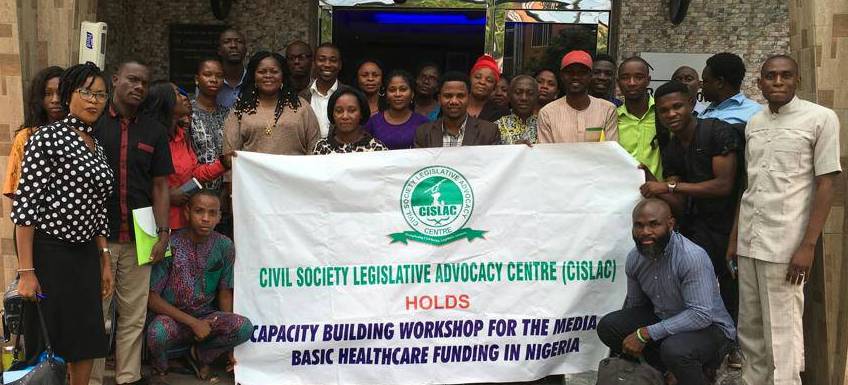
Bothered by this trend, and in order to have more media reportage focusing on primary healthcare systems and its challenges, the Civil Society Legislative Advocacy Centre (CISLAC) organised a media workshop on” Basic Healthcare Funding in Nigeria” for journalists in order to unlocking potential in primary healthcare financing through investigative journalism.
According to Dr. Jibril Bashar, Health Policy and System Development Unit, Ahmadu Bello University, ABU, who was a guest speaker at the workshop, health financing is a shared responsibility in which clients need satisfaction but that due to attitude of healthcare personnel, they are not getting the necessary health outcomes.
Speaking on the topic, “Financing for Primary Healthcare: Harnessing Domestic Funding Opportunities, Enabling Policies and Legislation” he said many people lack financial protection to access healthcare services. He therefore suggested that health care financing mechanism should provide sufficient financial protection so that no individual or household is impoverished because of the need to use health services.
According to him, “Public spending on health is about $7 (N2,500) per capital in Low Income Countries (LICs), over $100 (35,500) in Middle Income Countries (MICs), and $2600 (923,000) in High Income Countries ( HICs). Nigeria‘s out-of-pocket spending is 95.7% instead of the recommended benchmark of 20%.”
He noted that “Nigeria is 75.7% below benchmark: na dthat while “Nigeria is expected to spend N34,260, government is spending N1,671 for individual in 2018”. He noted further that “Most spending is on curative instead of preventive” and that “Nigeria budgets 5.95% instead of 15% for health.”
“Social health insurance accounts for about 1% of all health spending in LICs, 15% in MICs, and 30% in HICs. With the rebasing of Nigeria’s economy during President Goodluck Jonathan administration, Nigeria is now a Middle Income Country (MIC) and this should reflect in our standard of living. The country is no longer eligible for cheap loans to revitalise Public Healthcare Centres (PHCs)”, he added.
“If we have huge amount for concurrent, nothing will come up but capital expenditure will bring development. Funds are limited, needs are insatiable. It’s not possible to give the ministries all the money they need even in developed countries hence, the 15% benchmark in health,” he said.
Speaking on the maternal mortality rate in the country, he said there is delay in identification, delay in decision making, delay in accessing facility and delay at the facility. According to him, “National Health Insurance Scheme (NHIS) will go a long way to reduce catastrophe government spending. It will go a long way in sharing the burden.”
He noted further that “Nigeria has to prioritise public spending in health according to its own morbidity, mortality, and availability of funds. A great degree of impact can be made in making accessible health interventions at a low cost through sustainable domestic financing.”
On the state of PHCs across the country, Bashar urged the media to liaise with legislators saying, “We are far from it but there is room for improvement. We have less than 36,000 doctors in Nigeria, inadequate personnel who don’t derive satisfaction at work, but we believe we will get there. We have our challenges but policies are coming up.”
In her submission, Health Editor, Independent Newspaper, Chioma Umeha, called on the media to focus on public education on communicable and non-communicable diseases, nutrition, maternal/child healthcare. “Without PHC you can’t achieve Universal Healthcare Coverage (UHC). PHC can meet 80% health needs of a person throughout his/her life time,” she said.
In his message, CISLAC Executive Director, Mallam Auwal Ibrahim Musa , said that the situation of primary healthcare worsens, as financial and political commitment from the government is lacking and in cases where there have been pronouncements, they have been partially or entirely not implemented.
“The ultimate goal of the project is to promote policy implementation of government’s commitment to primary healthcare in Nigeria. This is so because, the challenges facing primary healthcare in Nigeria are complex and essentially arising from poor legal and regulatory frameworks and implementation, economic and socio cultural challenges.
“Also, a dearth of infrastructure, health personnel and equipment plaque the Nigerian primary health care system. Thankfully, health is on the concurrent list of the government. This only signifies that if indeed the government wants to pay attention to the prevalent health condition it can easily be achieved through serious implantation of health policies and redeeming of pledges at all levels,” he said.
“With your mandate to informing the public, you have the role to investigate these initiatives of the government to ascertain the progress made since its launch and also engage our state governments to ascertain how they are faring in adopting these initiatives in their development agenda,” he urged the participants.
In addition, the Programme Manager, CISLAC, Chioma Kalu , declared that media play important role if the country will achieve revitalisation of PHCs. According to her, “we feel that if we’re going to ask government to revitalize PHC, the media have important role to play; legislators are also very key and we can’t by any chance ignore the media. To bring about change, the media will write and get attention of duty bearers in PHC. Media should be carried along and do their own investigative journalism.”
Speaking on “Unlocking Potentials from Primary Healthcare through Investigative Journalism” she said it is expected of the media and civil societies to speak up on the deplorable state of health centres in the country, bad attitude of health workers and their being overworked, poor payment, crowding by patients, few health personnel.
Focusing on accessibility to health centres, affordability of health services and attendance at health centres, Kalu said, “It’s time we start doing things differently in this country and have ideas on how to change things in the country. Healthcare affects us directly and media should focus on it. Healthcare actually supposed to be provided by the government. The media should play the watchdog role in order to rebuild the PHC.”
Consequently, participants among others, recommended full-fledged community consultation in planning and processes establishing Primary Health Care to enable ownership, attendance and monitoring; strategic community-oriented advocacy in demanding accountability from the policy and legislative realms and strengthened judicial institutions to enable social equity and justice, and appropriate implementation of existing legislation.
In order to attain credible elections in Nigeria, the United Kingdom shall be spending the sum of 47.4m pounds towards the success of the 2019 general elections.
This was disclosed by Laure Beaufils, British Deputy High Commissioner, Lagos, while speaking at an interactive session with journalists to mark the 2018 International Day of Democracy.
At the event tagged: “Deepening Democracy in Nigeria,” held at the British Deputy High Commission in Lagos, the envoy stated that the UK is a long-term partner and friend of Nigeria in all spheres, including politics, adding that the Prime Minister, Theresa May’s visit to Nigeria is a testament that the two countries have a cordial relationship.
Beaufils noted that the British High Commission as part of the partnership to ensure a free, fair and credible general elections will spend 47.4 million pounds on Deepening Democracy in Nigeria Programme Phase 2 (DDiN2), adding that the programme funded under the Department for International Development (DFID), arm of the Commission, is geared towards supporting democratic governance around the world with focus on Nigeria.
According to Beaufils ,the UK “has no preference for any political party or candidate,” stressing that the nation is making efforts to provide advocacy and campaigns to support citizens-led groups to curb electoral violence.
Similarly, Damilare Babalola, Programme Coordinator, Deepening Democracy in Nigeria (DDIN2), said that the British Deputy High Commission is working assiduously with relevant stakeholders to strengthen democracy thereby resulting to credible elections results within the next six months.
He said that the DFID-UK funded programme has been in existence for the past four years to ensure successful 2019 elections in Nigeria, saying that it is working with the Independent National Electoral Commission (INEC), relevant security agencies, among other groups, to ensure voter-participation, participatory governance so as to sustain electoral process and intensify electoral process, as well as improve voter-participation in the elections.
Babalola said that the programme is an on-going process that supports civil society organisations, provides periodic intervention with public and works with relevant stakeholders to ensure an all-inclusive political process in the country. The project also reaches to the grassroots to ensure issue-based politics, peaceful and non-violent political process come 2019.
While noting that vote-buying among politicians is a “threat to peaceful elections if not contained,” he however admitted that “that there is so little that INEC or UK could do about that but the intervention of other stakeholders would help ensure that thuggery and violence are reduced to the barest minimum.”
In order to have a sane society that works for the common good of the citizenry, the role of the family and entrenchment of family values in the society cannot be overemphasized as the family plays a major role in nurturing society members and ensuring peace in the society.
However, over the years, decadence of family values has led to social vices and increasing societal upheaval. Consequently, there have been increase in the cases of rape, domestic violence, robbery and lately, the unabated use of drug and substance abuse among the youths in Nigeria. This is a major plaque that needed to be curbed if the country does not want to have generations of psychiatry patients as its teeming population. This is especially so as many Nigerian youths now indulge in drug and substance abuse.
It was based on the foregoing trends and in order to address the decadence bedeviling the society, that the Nigeria Association of Women Journalists, NAWOJ, Lagos state chapter organized its 2018 family week with the theme “Ensuring a Saner Society: Playing our Roles.” The essence is to remind parents of their roles in nurturing the children, youths in the right paths in order to have peaceful environment where every potential counts.
According to Lagos NAWOJ Chairperson, Hajia Sekinah Lawal, there is need to look at the issues of violence, drug and substance abuse holistically. “Government alone cannot do it. Government can ban tramadol, codeine, etc, but what of other substances our youths engage in that can’t be banned. As women professionals, through our writings, through our various programmes on television, radio, and social media, we should be able to do more, train the children through our profession”, she said.
“Parents should give the children quality time. How do we engage them positively? Can they confide in us? Are we the type that they will say when I get home, mummy and daddy will listen to me? What is the essence of doing what will endanger your life? She queried.
To ensure the saner society, she explained that especially for the youth, there should be access to best health facilities, quality education, infrastructure, urging everyone to be politically aware. “We must be involved in politics. Attend meetings in your wards, get your PVC, register and participate in any political party of your choice,” she said.
In his speech, the chairman of the occasion, Dr. Yekeen Habeeb, former Director, First Bank, declared that to build saner society starts at home. The former Kogi governorship aspirant urged parents to show love to their children. “Parents must love their children equally. Encourage them to develop positive attitude.”
In her address, Lagos State First Lady, Mrs. Bolanle Ambode advised the youths to desist from drug abuse. Represented by Mrs. Mosunmola Ogunleye, she said drug and substance abuse lead them to nowhere but total destruction. We must lead them close to God.
Speaking on the topic “Taming the Scourge of Drug and Substance Abuse” Dr. Omowunmi Bakare, Chairman, Medical Women Association, Lagos State opined that the bottom approach should start from home. According to her, parents should guide the children, youths, tell them the right thing about life that they need to challenge their brain and do not need to use drugs.
“When the brain is destroyed, the person is like a vegetable. Home is where we should start talking to children about drugs, side effects. Any drug is a poison. You need to use even the prescribed for certain period. We need to tell our children not to go near drugs. We need to advocate to relevant stakeholders in the society so that wrong people do not have licence to drugs,” she said.
Bakare also stated that there should be advocate to government to ensure relevant policies are made. “There are several outfits children can learn and exercise their energy. Traditional leaders, religious leaders are also important advocates. Let’s tell them about how to live well so that you can become great leaders in the society.
“Prevention is better than cure. We don’t want our children to be addict before we prevent. Monitor what they are doing. Love them but also be strict with them,” she said.
Also contributing, the Guest Speaker, Barrister Hauwa Shekarau, Country Director, IPAS Nigeria speaking on the topic, “The Impact of the Global Gag Rule on Sexual and Reproductive Health Rights in Nigeria” revealed that policy affects women in developing countries in which Nigeria is inclusive. According to her, the seminar is key in addressing social problem but stressed that the global gag rule will not allow people to access fund on abortion, information on abortion and awareness on abortion.
“The global gag rule applies to foreign NGO (non- governmental organization) working on maternal mortality, HIV, etc. As long as this policy continues, it will continue to bring disaster to women in developing nations. It decreases safe access to health. Contraceptive care is very important for women,” she said.
She however urged women professionals to speak against the global gag rule and let people know how dangerous it is to women’s health, the need to look beyond US funding and document how the global gag rule impact organizations.
On her part, Florence Udu, a family life coach speaking on “Protecting our Children from Sexual Abuse” said sexual abuse is increasing and majority of it are not reported. She declared that homo sexuality is increasing.
“We live in a society where wrong things are being accepted as right things. Sexual abuse is process whereby an adult take advantage of minors. Minors are also taking advantage of minors – senior minors. As well as teachers abusing students saying they want to make them big girls”
She explained that one of the tactics of the predator is cartoon bait, their favourite song urging parents to “spend quality time with the children. Social media has replaced family time. Our priority has been misplaced. Learn parenting. Family must be better for the nation to be better. Family value system must be entrenched. To have sane society, family value must be embraced”, she noted.
Chairman, Nigeria Union of Journalists, NUJ, Lagos chapter, Dr. Quasim Akinreti advised people to do good in the society and expect the society will be fair to you at the end of the day. “Phenomenon of end time is here. Those who will survive the end time are those who pray and have good conduct”. He said.
Also speaking at the event, the representative of Recare Cosmetics, makers of Natures Gentle Touch Hair products, one of the sponsors of the event, revealed that the company’s institute is set to commence a full-tuition scholarship to hair and beauty practitioners and those intending to go into the industry for a training session. He said this is in furtherance to the institute’s commitment to empower the African woman through effective and entrepreneurial beauty education.
Mr. Daniel Komlan, Technical Education Manager, Natures Gentle Touch who represented Recare Cosmetics urged NAWOJ members to seize the opportunity to acquire a new skill while emphasizing the need for proper care of the hair, if women want to have healthy luscious hair.
Speaking about Natures Gentle Touch products, he said: “Natures Gentle Touch products are made from natural products to help maintain a healthy hair and scalp as well as solve hair and scalp related problems experienced by Nigerian women and make customers look and feel great.”
Nigerian journalists have been encouraged to give women in politics more coverage in their daily reportage. The call was made by stakeholders in a media roundtable put together by International Press Centre (IPC), Humanity Family Foundation for Peace and Development (HUFFPED) and West Africa Network for Peacebuilding (WANEP) with the support of PEACETECH Lab.
At the event, WANEP presented the result of its online survey that showed that “women are not positively portrayed in the social media.” WANEP maintained that women participation in politics and assumption of a leadership role in the Nigerian political environment is pertinent and women should be encouraged to participate. It added that women participation could be achieved through the introduction and enforcement of a quota system.
A guest speaker at the event, Mrs. Yinka Shonubi, Editor, Health Style Plus Online, affirmed that the media has failed in giving women equal space they give to men in politics. She said that while men enjoy media presence, women were relegated and portrayed as second fiddle. She, however demanded that the media should stop the stigmatization of women and publications that could discourage them from aspiring for political positions.
Noting that, “Poverty is one of the hindrances to women contesting for political positions in Nigeria”, she posited that women should be granted the same opportunity as men.
“Women need to be given the same leverage and opportunity in politics to encourage more women in aiming for political positions”, Shonubi said. She further encouraged women to pull their weight to make their impact known and also urged the masses to support the right women to make them get to political positions/offices.
However, Mr. Bolaji Adebiyi, Editor of This Day newspaper, opined that the reason women are yet to get more media coverage could be because women in politics are not media friendly. He urged women to make a conscious effort in accessing the media.
“Women might not be media friendly which could be why they get less representation in media.
“Women should consciously approach the media and make information available to the media,” he said.
“Women have to put themselves in a position that when you come to me, you have a story to tell,” adding that it would make them get more representation in the media.
Also contributing, veteran journalist, Mr. Tony Iyare, stated that women would have to consciously strive to put themselves in the media.
“You don’t beg for power, you have to fight for it. Women should take strategic steps in using the media to make themselves known,” he said.
Meanwhile, the lead speaker, Mr. Lekan Otunfodurin, Managing editor, Online, Nation Newspaper, in his presentation, advised women to have thick skin that would enable them to absorb criticism and hate speech thrown at them in the media.
He also advised women to develop a strategy in making the media come after them for news.
U.S. Ambassador-at-Large for International Religious Freedom, Samuel Brownback, has urged Nigerian political office holders, representatives of civil society and religious leaders to avoid amplifying ethno-religious tension in the country and to focus on peace building.
At a one-day national youth dialogue on ethno-religious tolerance, organised by the U.S Consulate General Lagos, in partnership with the African Youths Initiative for Crime Prevention (AYICRIP), Ambassador Brownback, who met with a group of religious leaders during a recent visit to Nigeria, commended increased inter-faith engagement and dialogue in Nigeria, but noted that the country can do more to protect citizens’ right to religious freedom.
“When I visited Nigeria in June, I met with communities from all different faiths located all over the country and heard about how interfaith groups and people from every religion have come together to begin stopping the violence at the community level, which is a great starting point,” Brownback said.
“However, we need to do better than just achieving tolerance; we need to truly care for each other. The people who stand for peace do not do this because they are from the same ethnic group, or because they share a common religion. They believe the lives of everyone are sacred,” he added.
U.S. Consul General John Bray, who opened the event, reaffirmed the United States’ commitment to supporting initiatives that promote peace and admonished Nigerians to ensure that cyclical communal violence does not threaten national unity.
“Each of us has a role to play in tamping down tensions between communities of all kinds,” Bray noted.
“It is in your hands to ensure that this tragic violence does not descend into broader ethnic and religious fighting, and a cycle of reprisals. We must all make sure that the fighting does not eat away at the fabric of Nigeria, the multi-religious and multiethnic tolerance that makes this a great and unified nation,” he said.
Media Rights Agenda (MRA) and the Kenya ICT Action Network (KICTANet) have launched “The African Union: a guide for human rights defenders in the digital age“, an advocacy tool designed to enhance civil society engagement with the African Union system on digital policy issues.
In a joint statement, the two organizations hinged the publication of the advocacy guide on the fact that the AU is an important political actor on the African continent and a regional interlocutor in the international arena, which makes it imperative that organisations seeking to advance respect for human rights in digital policy have the right knowledge and skills to engage the AU.
They explained that the aim of the 43-page guide is to help civil society organisations who are conducting or intend to conduct policy advocacy within the African Union system on the human rights aspects of any ICT or digital policy issues at the AU, including for example network disruptions.
Mr. Edetaen Ojo, MRA’s Executive Director and Ms Grace Githaiga, Co-Convenor of KICTANet, said: “Whether you have experience of engaging with the AU but are lacking ideas on how to use the AU to advocate for human rights in the digital age, or an experienced digital rights defender unfamiliar with the AU, this guide is for you!”
The guide presents an overview of relevant organs, departments and agencies of the African Union, outlines how they operate and provides guidance on the opportunities that exist for civil society as well as strategies for ensuring effective advocacy engagement on relevant digital policy issues.
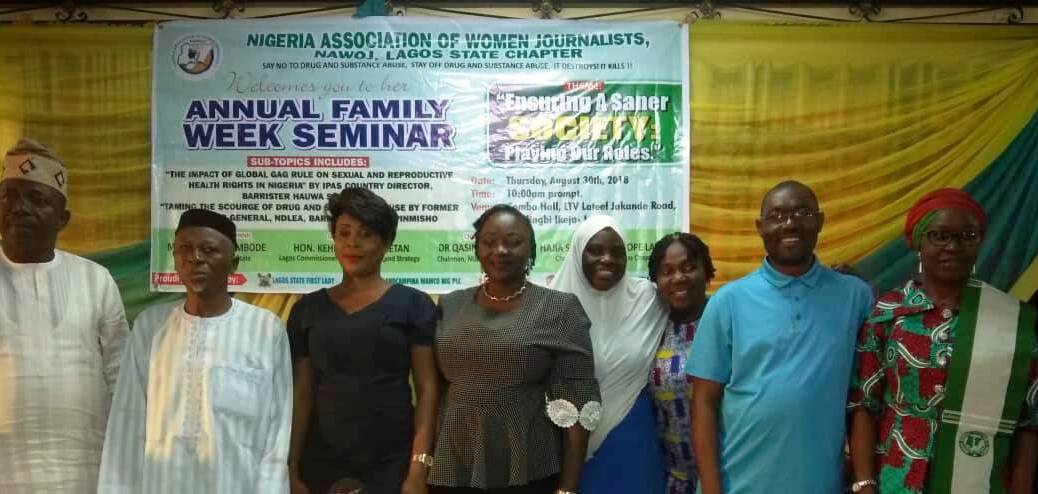
 In her address, Lagos State First Lady, Mrs. Bolanle Ambode advised the youths to desist from drug abuse. Represented by Mrs. Mosunmola Ogunleye, she said drug and substance abuse lead them to nowhere but total destruction. We must lead them close to God.
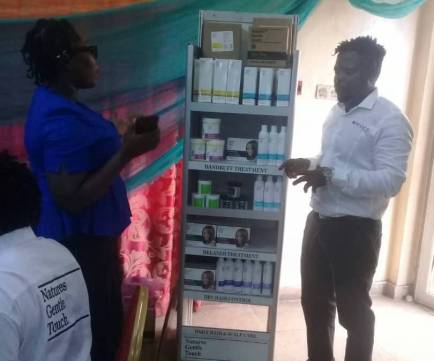 Also speaking at the event, the representative of Recare Cosmetics, makers of Natures Gentle Touch Hair products, one of the sponsors of the event, revealed that the company’s institute is set to commence a full-tuition scholarship to hair and beauty practitioners and those intending to go into the industry for a training session. He said this is in furtherance to the institute’s commitment to empower the African woman through effective and entrepreneurial beauty education.
 Social Development News (SDN)