IPC condemns arrest, demands release of photojournalist

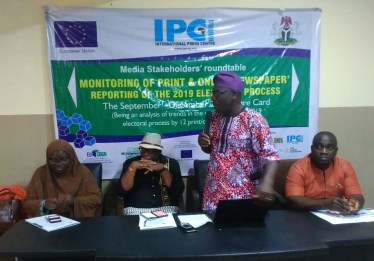
The International Press Center, IPC, has demanded the immediate release of Yinka Badmus, a photojournalist with Talk Village International in Lagos.

In a report by Vanguard Newspaper dated January 11th, 2019, Badmus, 24, was arrested on New Year eve by policemen attached to the Lagos State Anti-Cultism unit for wearing dreadlocks, which the officers allegedly said made him look like a cultist while eating noodles at Pedro Bus stop, Gbagada, Lagos.

In a statement, Lanre Arogundade, Director, IPC, said it was unconstitutional for him to have been detained for many days before he was eventually arraigned and remanded on the orders of an Ogudu Magistrate Court, Lagos.

 Arogundade pleaded with the Lagos State Commissioner of Police to step into the matter so that the photo journalist could regain his freedom.

The IPC Director also enjoined journalists to be mindful of their safety and ensure they have a means of identification on them at all times.

Yinka Badmus is currently being held at Ikoyi Prisons.

Enhancing best journalism practices in 2019 elections and beyond

=By Funmi Falobi=


As 2019 elections are gathering momentum, Nigerian journalists have been tasked to shun hate speech and embrace best practices in the electoral reportage.

Similarly, journalists are also urged beyond reporting, to have the mindset of entrepreneurs in order to harness opportunities.

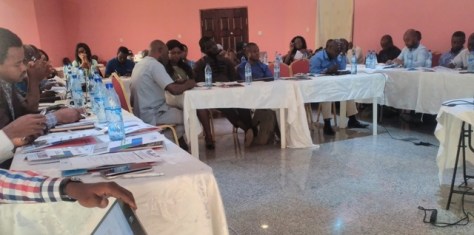
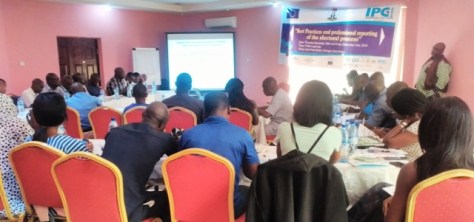
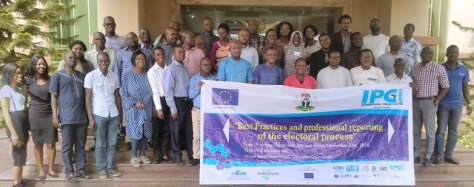
This was the submission at a two day workshop organised by the International Press Centre (IPC) in conjunction with European Union support to Democratic Governance in Nigeria (EU-SDGN) for journalists in the South West region held at Osogbo, Osun State with the theme, “Best Practices and Professional Reporting of the Electoral Process.”

According to the IPC Director, Lanre Arogundade, the event was organised to critically examine the interconnections between the public, the media and elections towards developing an agenda that seeks to strengthen the role of the media in facilitating a credible electoral process.

“It is expected that this training will help participants to understand and imbibe the principles of fairness, diversity and objectivity in reporting the electoral process and the elections with the anticipation that this meeting will provide an integral opportunity for journalists to share their experiences to ensure best practice reporting for the 2019 elections,” he said.

img_20181220_114304


In his speech, Muyiwa Popoola, Professor of Journalism, Communication and Media Studies, Ajayi Crowther University, said the way the media report issues contributes to conflict and violence.

img_20181220_114220Speaking on the topic, “Towards 2019: Avoiding Hate Speech and Being Conflict Sensitive in Election Reporting,” Popoola said Nigerian reporters have responsibility to cover the fact but avoid stoking hate speech.
“Nigerian media professionals should always endeavour to evaluate before they publish. They should be conflict sensitive oriented by adopting Conflict Sensitive Reporting (CSR) style. How we report conflict determines our safety in the land,” he said.

While enjoining journalists to uphold ethical professionalism in reporting the 2019 elections, the university don said, “As journalists, we should not just be searching for scoops, we should research, we should not be lazy journalists. In our reportage, we should look for shadow parties to reduce political conflict in the country.”

 On his part, David Ajikobi, Nigerian Editor, Africa Check, took participants on eliminating bias in election reporting.

He enjoined journalists to get new skills necessary in fact checking and use such to present correct facts since readers tend to believe more in what they read from journalists.

Warning journalists not to fall victim of fake news, Ajikobi declared that in the next elections, fake news will be a threat – Facebook, Whatsapp, Twitter, fake news websites.

“A fact is what can be checked and backed up with evidence. Asking questions is the basis of fact checking. It makes leaders accountable before they act,” he said.

The fact checking expert took journalists through some tools they could use to verify pictures often used to propel fake news.

“As journalists you must be careful not to fall for fake accounts when you are using the social media as news source because your credibility built over the years can vanish when you share false information,” he warned.

Consequently, Taiwo Obe, Founder, Journalism Clinic, advised journalists to have the mindset of entrepreneurs.

Using his own media experience, Obe, who had invested over 40 years in journalism, went beyond the training outline to encourage journalists to think differently in order to maximise their career opportunities.

Speaking on the topic entitled “Enhancing Election Reporting in the Digital Age,” Obe said,

“If you have not trained your mind in what you do daily I want you to re-condition it and if you are not critical about your thoughts, you would be doing the same routine. It is necessary to do a self worth analysis.

Internet has no boundary don’t limit yourself. It is inferred that journalism has moved don’t limit yourself.”

Obe also took participants through career enhancing tools necessary for 21st century journalists. This include: Quick, Anchor, Google earth, Nimbles, Facebooklife among others.

img_20181220_121713

1,252 benefit from Lagos agricultural value empowerment programme


By Funmi Falobi


Lagos State Governor, Akinwunmi Ambode said that 1,252 farmers have been empowered by the State Government under its agricultural value and empowerment programme aimed to reduce poverty in the State.

Ambode who made this known at the flag off ceremony of the 2018 Agricultural Value Chains Empowerment Programme noted that the 1,252 farmers in the state have been supported in various farming enterprise and empowered to boost their productive capacities in line with the State’s food security objective.

The governor who was represented by the Commissioner for Agriculture, Mr. Oluwatoyin Suarau stated that the programme is a strategic approach employed by the state government to enhance productivity and improve standard of living of small holder farmers, fishermen, agro processors and marketers through the provision of inputs, productive assets and capacity building so as to ensure the steady supply of food to Lagosians.

He noted that food security became a major challenge as a result of the drastic decline in oil revenue stressing that it has now become imperative to conserve foreign exchange by reviving the agricultural sector through policies and programmes that will encourage more people to go into farming and increase food production.

Ambode added that the state government as a matter of policy has ensured that basic infrastructural facilities are evenly distributed across the state especially in rural communities despite the fact that most farming activities are based in the rural and semi urban areas.

“Our objective is to make our communities liveable and centres of economic activities. This strategy we believe will reverse the trend of rural to urban migration and also make farming more attractive especially to young people,” he said.

While stressing that his administration is committed to ensuring food self-sufficiency for the teeming population through well designed and thought initiatives, the governor said that his administration will not relent in its effort to encourage farming activities in the rural communities by reducing the infrastructural gap between rural and urban centres.

He added that the State Government has procured a 32 metric tons per hour rice mill to sustain the production and processing of local rice in the state which will create over 500,000 jobs in form of manpower to operate the mill directly.

Earlier in his address, the Permanent Secretary, Ministry of Agriculture, Dr. Olayiwole Onasanya explained that the state government through various  farming enterprises which include  egg marketers, piggery, butchery, poultry production, vegetable production, perishable produce trading, sheep and goat production, aquaculture, fish feed input, artisanal fisheries and fish processing is working towards food sufficiency .

IPC condemns shooting of journalists at APC Lagos rally

The International Press Centre (IPC) is highly concerned about the reported gun-attack on journalists who were covering the Lagos State rally of the All Progressives Congress (APC) in Lagos on Tuesday, January 8, 2019.

According to news reports, among those that were affected by the unwelcome activities of gun wielding elements were the group political editor of The Nation Newspaper, Emmanuel Oladesu, News Telegraph correspondent, Temitope Ogunbanke and Ibile Television cameraman, Abiodun Yusuf.

The News Editor of The Nation confirmed the incident to IPC stating that Mr. Oladesu was hit by a stray bullet and was receiving treatment in a hospital although in stable condition.

In a signed statement by the Director, Lanre Arogundade, IPC hereby reminds all political parties that the Nigerian Media Code of Election Coverage obligates them to ensure the safety of journalists covering their activities including campaigns.

The organisation therefore calls on the Lagos APC to urgently take appropriate steps to apprehend the alleged perpetrators of the bizarre attack with a view to handing them over to the law enforcement agencies for immediate prosecution, also as provided by the Code of Election Coverage.

IPC calls on all journalists covering the ongoing campaigns to keep themselves abreast of all safety measure.” They should learn to stay away from political activities where rival gangs engage in show of force especially through display of weapons.

Journalists covering the elections should also bear in mind that they constitute dangerous assignments requiring them to take insurance cover especially from their employees,” Arogundade said.

IPC appeals to the security agents on electoral duty, especially the Police, to consider the protection of journalists as part of their responsibility as envisaged by and indeed provided for by the Nigerian Media Code of Election Coverage.

Reducing postpartum mortalities: Safeguarding pregnant women through effective drug administration

=By ‘Sanmi Falobi=

“From the evidence available, 28% of all maternal death in Nigeria is caused by excessive bleeding after child birth. 28% means that in almost every four women, one of them die as a result of Postpartum Hemorrhage and that is something that needs attention in terms of addressing maternal deaths in Nigeria”.

Maternal mortality and consequential social dysfunction
Sitting with a forlorn face and wondering what the future now holds, Mr. James Ogbe’s* life has not been the same following the sudden death of his wife as a result of post-delivery bleeding she experienced few hours after the birth of their second child. With a six year old girl and the new baby to now take care of, James Ogbe is not only mourning the untimely death of a loving wife, but also faced with the task of taking care of his two young children alone.
“How do I live on with life now? Where do I start from”, he said, with a voice laden with sadness. Why did she have to die? Please take away the baby, give me my wife back. Please give me my wife back!”, he demanded, expecting an answer from the nurse, that Saturday morning, minutes after he was told that his wife had died.

“I don’t want this baby, just give me my wife. Please give me my wife”, he repeated, with eyes fixed on the walls, above the nurse who was carrying his new-born baby. As he looks on at the wall vaguely, droplet of tears streams down his face. “Please give me my wife”, he muttered again and again, as a family member and another, a member of his church, rally round to hush him from further lamentations.

‘When she delivered, there were no issues at all. The labour period didn’t take long and the delivery was also normal. There’s wasn’t any much anxiety throughout it all. We had talked for some minutes after giving birth and we were even already hoping she would be discharged by the next morning”, Ogbe recounted.woman. after delivery

“The next thing I heard later was that she was bleeding and that she needed extra blood as she had used three pints already. I was told that she may need a fourth one, so I had to go in an ambulance from the General Hospital, Ijaiye to Island Hospital, Lagos to get extra blood as their stock was already exhausted. By the time I came back with the blood, they told me she had died” Ogbe explained.

“How can she die from bleeding? Somebody that was okay and I saw and spoke with? I got the blood she needed, yet she still bled and died, why? How?”, he asked, lamenting.

Now, months later, with wife buried and family support rendered, the reality of the loss of a dear wife and the challenge in taking care of two little kids has gradually re-shaped the horizon for James Ogbe. Though the support from family, relatives and church members had helped in gradually and slowly dissipating the grief, there yet remain an un-answered question in the heart of James Ogbe and many others, relating to the circumstances that led to his wife bleeding to death after what seems to be a successful delivery of his second child.

“We picked that hospital because it was one of the best general hospital in Lagos. Why things twisted is still a mystery, and I wake up everyday seeking for answers”, he notes, as he tries to pick up his life again, each day driving home the reality that he has become a widower at just 36!

Understanding Postpartum Hemorrhage
James Ogbe’s questions may remain un-answered, as it is with many Postpartum Hemorrhage deaths in Nigeria. According to a 2016 report by the International Journal of Women’s Health (IJWH), post child-birth bleeding, medical known as Primary Postpartum Hemorrhage (PPH) is defined as blood loss from the genital tract of 500 mL or more following a normal vaginal delivery or 1,000 mL or more following a cesarean section within 24 hours of birth.

Giving a more simplified definition, the World Health Organization (WHO) in its June 15, 2017 recommendations on the World Maternal Antifibrinolytic (WOMAN) Trial on Prevention and Treatment of Postpartum Hemorrhage, defined PPH as a blood loss of 500 ml or more within 24 hours after birth. It noted that PPH is the leading cause of maternal mortality in low-income countries, and the primary cause of nearly one quarter of all maternal deaths globally. It was stated that most deaths resulting from PPH occur during the first 24 hours after birth. Interestingly, the WHO report also pointed out that the majority of PPH death could be avoided through the use of prophylactic uterotonic during the third stage of labour and by timely and appropriate management.

In Nigeria, an organization established as a response to the rising maternal morbidity and mortality rates in the country, the Community Health and Research Initiative (CHR) also shares the same concerns with the WHO, that timely and appropriate attention to post-delivery bleeding is critically important, especially because PPH occurs without warning, and a woman with severe PPH can bleed to death within a few hours if not rapidly and adequately treated.

mother-child.jpg

As part of advocacy efforts to address the mortality resulting from PPH, an advocacy brief by CHR, titled, ‘simple facts about postpartum hemorrhage’ notes that the main cause of PPH is the failure of the uterus to contract after childbirth due to a number of reasons including lacerations in the birth canal, uterine rupture, retained placenta tissue and blood coagulation disorders. The document however noted that, “PPH can be prevented through the provision of appropriate medication and the administration of a class of medicines called uterotonics”. According to the advocacy brief, “postpartum hemorrhage death could be prevented if all women were given a high quality uterotonic immediately after delivery.”

The challenges in using Oxytocin in PPH prevention
Giving an insight about PPH, Dr. Musa Mohammed Bello, a Consultant Public Health Physician and member board of trustees of CHR, explained that Postpartum Hemorrhage which literally means excessive bleeding after child-birth is a condition that is very common among women and child delivery in Nigeria.

“We all know that in developing countries like Nigeria, maternal mortality or death of women during pregnancy, child birth or after child birth is very common, especially in Africa”, he said.

He further pointed out that though PPH deaths are easily preventable by the administration of an uterotonic drug, which helps to stop a woman from bleeding after child birth, he however emphasized that the conditions of storage and handling of the drug matters.

dr-bello.jpg
Dr. Musa Bello

“Actually there are drugs that are supposed to be used to prevent Postpartum Hemorrhage. These drugs are very good, and they have been experimented and recommended to be used. These drugs have an umbrella name called uterotonic, which means group of drugs that causes contractions of the uterus of the womb after child birth. There are many of them, for example, there is Oxytocin injection, there is Egometrine injection, and there is Misoprostol tablet”, he explained.

“Out of these, Oxytocin is the most preferred first line drug of choice, but there is an issue with it in that it requires maintenance of content; you need to store it in a cold compartment between a temperature of 2 to 8 degrees Celsius for it to remain effective, but unfortunately, in developing countries like ours, we have problem with power so maintaining the content, refrigerating because of electricity problem is usually difficult, so these drugs are not performing the functions we expect them to perform, because of the heat nature”, he added.

Expatiating, he said: “So you find out that a woman has delivered, she’s bleeding and they gave her Oxytocin injection 3-4 times and it’s still not working because it has lost what we call efficacy due to temperature effect”.

Also giving credence on the need for a proper policy framework for the procurement and distribution of essential drugs, the National Chairman of the Association of Community Pharmacists of Nigeria (ACPN), Comrade Samuel Adekola, a pharmacist by profession, noted that despite all the effort to reduce maternal mortality in Nigeria, a critical mass of women still die with PPH being one of the leading causes of such deaths. While agreeing that Oxytocin as a first choice of drugs could be used to manage the situation, he however pointed out that for oxytocin to be effective, it must be stored at a specified temperature at all times.

sameul adekola 2
Comr. Samuel Adekola

“Oxytocin is the preferred first line drug of choice for the treatment of PPH. However it is the drug that has peculiarity in terms of transportation and storage, as it has to be stored between 2 and 8 degree Celsius. The drug has to be in a cold storage system at all times for it to remain effective. This is the challenge because of our environment, we have the problem of light and the problem of infrastructure. The fridge for storing a vaccine like oxytocin is not available in many places and where it is available, there may be no electricity to power them and yet people still give the drug, because it is there in the store”, he noted.
“Unfortunately, there is no means of knowing whether the temperature and the environment have affected it (Oxytocin), so they still give it because it is there in the store, irrespective of whether the condition of storage is as prescribed”, he pointed out.

“It is this challenge of the storage of Oxytocin that has given rise to research and development to another variety known as Carbetocin, which has been tested and proven and is now the drug being advocated, for the treatment of Postpartum Hemorrhage”, he added.

From Oxytocin to Carbetocin, hope rises
It would be recalled that sequel to the need to address the challenges associated with the use of Oxytocin in humid regions, the Word Health Organization (WHO) in June 2018 announced the report of a study on the formulation of a new drug for the treatment of postpartum hemorrhage in low and middle-income countries. In the study, published in the New England Journal of Medicine, an alternative drug – heat-stable Carbetocin – was recommended to be as safe and effective as Oxytocin in preventing postpartum hemorrhage.
“This new formulation of Carbetocin does not require refrigeration and retains its efficacy for at least 3 years stored at 30 degrees Celsius and 75% relative humidity”, a portion of the study stated.

The clinical trial, the largest of its kind, studied close to 30 000 women who gave birth vaginally in 10 countries: Argentina, Egypt, India, Kenya, Nigeria, Singapore, South Africa, Thailand, Uganda and the United Kingdom.

“The development of a drug to prevent postpartum hemorrhage that continues to remain effective in hot and humid conditions is very good news for the millions of women who give birth in parts of the world without access to reliable refrigeration,” Dr. Metin Gülmezoglu of the Department of Reproductive Health and Research at WHO, had said.

Acknowledging the WHO report, Comrade Adekola notes that Carbetocin has the advantage that it does not require any special condition other than keeping it at the normal room temperature. So it is a good alternative for effective treatment of PPH.

“This drug has been tested and would soon be released by WHO as the first line choice for the treatment of PPH. It is an injectable like Oxytocin, and also heat stable.
“We are calling on government at the national, state and local level to make this drug available, as it has the advantage that it can be stored at room temperature and there are no environmental factors affecting it like Oxytocin. Government should therefore do what they need to do to make this drug available so that every pregnant woman can have access to this drug, when the need arises”, he added.

Meanwhile and in the same vein, Dr. Aminu Magashi Garba, Coordinator, Africa Health Budget Network, Abuja is urging for a multi-stakeholders involvement in mitigating maternal mortalities in Nigeria.

“From the evidence available, 28% of all maternal death in Nigeria is caused by excessive bleeding after child birth. 28% means that in almost every four women, one of them die as a result of Postpartum Hemorrhage and that is something that needs attention in terms of addressing maternal deaths in Nigeria”, Dr. Magashi Garba noted.

dr aminu
Dr. Aminu Garba

“One thing we advocate for is that the government has to put money down in purchasing quality drugs that will stop bleeding after child birth. Quality drugs is beyond just buying a drug but also involve the process of transportation and the storage of such drugs. Government, in ensuring the quality of drugs must also put into consideration the conditions of storage and distribution process. So in the situation now that government cannot do that, we are in support of the alternate drug called Carbetocin which can be under normal room temperature for up to three years and is also an injectable that is effective like oxytocin”, he said.

Forging a common front through advocacy
Working in collaboration with CHR, Dr. Magashi Garba noted that the CHR and partner organizations are already undertaking a number of advocacy initiatives to rally stakeholders support involving the media, civil society as well as government agencies, especially relating to health matters, on measures to mitigate maternal mortality in Nigeria.

“As an organization, we are focusing on advocacy to the key stakeholders that we believe take decisions relating to procurement, storage and distribution of drugs; those that take decision concerning the type of drugs that should be in our essential drug list that need to be put at federal and state level for procurement and then those who are the key frontline health workers that needs to be sensitized on the use of this new drug, Carbetocin in the treatment of PPH.

‘We need to sensitize our people and involve all stakeholders about the burden of postpartum hemorrhage and maternal mortality so that all women delivering in the health facility will receive the care they are supposed to receive’ he added.

The need for enabling policy framework

Meanwhile, it is a welcome development to note that the Nigeria Health Ministry has also endorsed the WHO formulation of Carbetocin as effective as oxytocin, for the prevention of excessive bleeding. According to the Nigerian minister of health, Professor Isaac Oyewole, speaking at a health forum on eradication of Polio, in Kano, the WHO recommended heat-stable formulation of Carbetocin, is a ‘welcome development, and capable of lowering incidence of death among Nigerian women during childbirth.’

This statement by the Minister, it is hoped, will translate to a policy that aids pregnant women to better cope with post child-birth bleeding issues through an effective drug administration mechanism that ensures the provision and use of Carbetocin as a key essential drug for the treatment of postpartum hemorrhage in Nigeria.

However, though Carbetocin, manufactured by Ferring Pharmaceuticals is available in Canada, the United Kingdom and many other countries, there is still the need to have some advocacy in creating the enabling policy framework to list it as an essential drug in the treatment of PPH in Nigeria and many other Africa countries.

Though, human error sometimes may contribute to mortalities, an effective drug administration mechanism, would certainly help reduce maternal mortality and save pregnant women from dying, thereby eliminating the social dysfunction associated with the such deaths during child-birth; either as a mother, or as a wife.

………………………………………………………………………………………………………………………………

*Editor’s note: *James Ogbe is herein used as a pseudo name.
Image credits: Wendy Marijnissen, 100huntley, babycenter.com

…………………………………………………………………………………………………………………………………

Speaking out: Joining voices to end gender-based violence

=By Funmi Falobi=

Gender based violence remains a growing problem in Nigeria and across Africa.

See short Video Campaign: Speaking out: Joining voices to end gender-based violence

Do you know that in every five minute around the world, a woman or a girl dies from violence?

In Africa, women are raped, sexually harassed at work or in school while girls get raped and given out in early marriage.

According to a UN report, 60% of Ethiopian women were subjected to sexual violence while it is estimated that over 40% of South African women will be raped in their lifetime and only one in four rapes are reported.

It is expected that all hands must be on deck to break the culture of silence and end violence against women and girls.

#EndViolenceAgainstWomen&Girls.

UN, US call for end to violence against women, girls

=By Funmi Falobi=

United Nations, UN and United States of America, USA, have called for concerted action to end violence against women and girls around the globe.

The call came as the world commemorates this year’s International Day for the Elimination of Violence against Women. The 16 days of Activism against Gender-Based Violence is an international campaign to challenge violence against women and girls. It takes place annually from November 25, the International Day for the Elimination of Violence against Women, to December 10, Human Rights Day.

Statement by the Heads of UN agencies, UNDP, UNICEF, UN Women and UNFPA, called for solidarity with survivors and survivor advocates and women’s human rights defenders who are working to prevent and end violence against women and girls.

Secretary-General’s UNiTE Campaign said, “ Our duty is not only to stand in solidarity with them but also to intensify our efforts to find solutions and measures to stop this preventable global scourge with a detrimental impact on women’s and girls’ lives and health.”

“More than a third of women worldwide have experienced either physical or sexual violence at some point in their lives,” the statement said. Furthermore, research indicates that the cost of violence against women could amount annually to around 2 percent of global gross domestic product (GDP). This is equivalent to 1.5 trillion dollars.

Beyond raising awareness, governments, the private sector, the artistic community, civil society organizations, academia and engaged citizens are again looking into new ways to urgently address this global scourge.

For more than 20 years, the UN Trust Fund to End Violence against Women (managed by UN Women) has been investing in national and local initiatives that translate policy promises into concrete benefits for women and girls, and contribute to the prevention of violence in the long run.

As part of the Spotlight Initiative to end violence against women and girls, a global, multi-year partnership between the United Nations and the European Union, we are working with different partners to increase the scale and level of ambition of our interventions. We understand that reducing and preventing violence against women is transformational: it improves the heath of women and children, reduces risks of acquiring HIV and sexually transmitted infections (STIs), improves economic productivity and educational attainment, and reduces the risks of mental illness and substance abuse, among other benefits.

GENDER VIOLENCE 2
L-R: National Information Officer, United Nations Information Center, Dr. Oluseyi Shoremekun; U.S. Consul-General F. John Bray; Deputy-Governor, Lagos State, Dr. Idiat Adebule and Convener, Women Arise, Dr. Joe Okei-Odumakin  flanked by guests, at the Public Lecture.

Similarly, U.S. Consul General John Bray on Monday urged Nigerians to take a firm stand against impunity, stigma and the culture of silence which fuel violence against women and girls in the country.

Speaking at a public lecture organized by the rights group Women Arise and the United Nations Information Center, to mark the commencement of 16 Days of Activism Against Gender-Based Violence, Bray noted that curbing escalating violence against women and girls would require candid testimony by survivors and open discussion of the societal factors that perpetuate gender-based violence.

“Women and girls in Nigeria must join their sisters across the world in raising their voices to say that we must break the culture of silence by bringing these stories to light. It is only by such exposure that we can rapidly bring the violence against women and girls to an end,” he said said.

The U.S. envoy also made a case for joint action by different stakeholders to forestall violence against women while taking legal action against offenders.

“We must work together as stakeholders, in order to be proactive and curb the violence against women and girls Where we fail to prevent such violence, it also important to make those who engage in violence and abuse know that there will be no impunity for their crimes, that society is outraged by such behaviour and they will be identified, they will be denounced, prosecuted, and punished,” Bray said.

Other speakers at the event included Dr. Idiat Adebule, Lagos State Deputy Governor and Dr. Joe Okei-Odumakin, human rights activist and founder, Women Arise. They were joined by the National Information Officer of the United Nations Information Center, Dr. Oluseyi Shoremekun.


Floral School elects new prefects, urges them on quality leadership

=By our correspondent=

The Floral Schools, comprised of nursery, primary and college, have elected new prefects and class representatives for the 2018/2019 academic year.

 Speaking at the swearing-in programme, the Proprietress, Mrs. Kemi Bamidele said that the event is an opportunity to see that the children are exposed early in life into leadership position, adding that parents should assist their wards in embracing quality leadership.

 She said, “What we are doing today is not ordinary. It is time to see the children appointed early in life. Parents should teach them to be good leaders and let them see what it entails to be a good leader. Let them come to school on time, do the right thing at the right time and we shall see them in greater heights in life.”

index11

index9 Cross section of class captains and prefects

index13

 In her speech, the Head Teacher, Nursery, Mrs. Tayo Taiwo explained that aside academic qualification, the school also looked at some qualities before choosing the class representatives and electing the prefects.  She said the school teaches leadership and character building and called on parents to help the pupils and students grow better daily in good leadership qualities.

 “Aside academics, we look at character and we want them to know that personality is important and that they are not ordinary. We saw some qualities like patience, tolerance, leadership roles before choosing them and we want parents to please maintain those qualities.

 “We see the stars in them and as parents, let’s nurture them, teach them the word of God, pray for them and pray with them. Teach them to obey authority, parents and teachers. Children, you are going places in life,” she said.

Also contributing, Head Teacher, Primary, Mr. Femi Roberts told the children that leadership position is not part of the fundamental human rights but that they must earn it. “Leadership position is not your right, you must earn it. You must learn to be responsible aside academic prowess”, he noted, charging them to behave and conduct themselves in a manner to meet up the expectation of their appointment and election as class captains and school prefects, respectively, and that the leadership qualities they possess should be manifested beyond the school environment.

thumbnail (2)

index4

thumbnail (1)
The swearing-in ceremony

 Similarly, the Chairman of the Election Committee, Mr. Sunday Bankole declared that the election was free and fair. He said the children campaigned and presented their manifestos before emerging winners in respective positions.

 “These children are great. What we are doing today is not just fun, parents should guide the children. We had ballot boxes and papers for the elections, the pupils voted and we have the results. There was a rerun for two candidates and this also helped the pupils in understanding leadership.  You should not be angry if you do not win the post you vied for, but every one of you is a winner and you all are prefects,” he said.

 Barrister Olufemi Abodunde, who conducted the swearing-in exercise, the urged the elected prefects to be consistent and have sense of duty.

 Meanwhile, speaking on behalf of the prefects in the primary section, the Head Boy, Romilogo Falobi, thanked the teachers and parents for their supports and the pupils for believing in them. “I want to thank my parents for their support. I thank my teachers for teaching me leadership. And on behalf of other prefects, I thank the pupils for voting for us. We will do our best to make the school better”, he said.

index1
Barrister Olufemi Abodunde, Romilogo Falobi and Mrs. Kemi Bamidele
index3
With Parents, Mr & Mrs Sanmi Falobi
index2
With fellow prefects and their parents

… Enhancing socio-economic and sustainable development issues & initiatives.