Category Archives: Uncategorized

World Malaria Day: U.S. partners Nigeria in prevention, treatment

By SDNonline

In its Annual Report released to the U.S. Congress, the President’s Malaria Initiative (PMI) said that in 2020, despite the constraints of COVID-19, PMI helped Nigeria provide 14.7 million treatment doses at the facility and community levels, 8.2 million of which were for pregnant women and children.

PMI distributed 7.1 million insecticide-treated mosquito nets (ITNs), provided 7.2 million rapid test kits, and trained 9,300 health workers to properly diagnose and treat patients for early detection of the disease.

Led by the U.S. Agency for International Development (USAID) and implemented together with the U.S. Centers for Disease Control and Prevention (CDC), PMI works with partner organizations to benefit more than 41 million people across Nigeria.

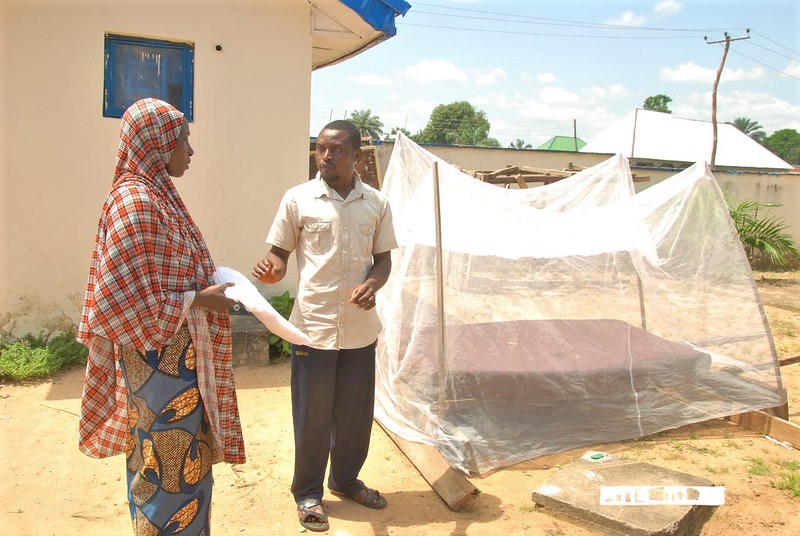
Use of ITNs is one of the most effective measures to prevent malaria. Since 2010, PMI has supported Nigeria in the distribution of more than 61 million bed nets, which are now in use in 43 percent of Nigerian households, up from just 23 percent at the start of the initiative.

“Malaria is one of the leading causes of death among children in Nigeria,” said USAID Mission Director Anne Patterson, who oversees PMI activities in collaboration with CDC leadership. “We are pleased to see our partnership with Nigeria has had clear success and will continue this support with proven methods of prevention and treatment against malaria.”

Nevertheless, malaria remains an onerous burden among the poorest and the most vulnerable echelons of Nigerian society. During pregnancy, the disease can pose a life-threatening risk to both mothers and babies; malaria also causes adults and children to miss work and school, contributing to economic hardship.

PMI works with Nigeria’s National Malaria Elimination Program to scale-up proven, cost-effective, and life-saving malaria control interventions centered around ITN distribution, intermittent preventive treatment for pregnant women, diagnostic testing, and treatment.

Simultaneously – and equally important – PMI helps to strengthen health systems and build the skills of health workers to deliver malaria services. PMI also enhances the capacity of federal and state health officials to manage malaria control activities.

U.S. Global Malaria Coordinator Raj Panjabi said, “Science shows we can beat malaria and we can beat it in our lifetime. Yet we need bold action to stop COVID-19 from holding us back. The United States is proud to partner with Nigeria to continue the fight.”
U.S. launches new $90 Million malaria control effort in eight Nigerian states

-By FUNMI FALOBI-

U.S. Agency for International Development (USAID) Mission Director Anne Patterson joined Dr. Perpetua Uhomoibhi, Coordinator of Nigeria’s National Malaria Elimination Program on Tuesday to launch a new activity to control the country’s leading killer of children – malaria – in rural areas of eight vulnerable states.

Over the next five years, the $90 million President’s Malaria Initiative for States (PMI-S) will serve as the flagship activity for the global U.S. President’s Malaria Initiative (PMI) in Nigeria. Since 2010, PMI has provided $712 million in investments, including the distribution of over 61 million insecticide treated bed nets (ITN), which are now in 43 percent of all households, twice the rate before the intervention.

“In Nigeria, members of low-income households in rural areas are seven times more likely to contract malaria than urban dwellers,” Patterson said. “Because these communities also have limited access to prevention and treatment services, it is critically important to reach these populations to reduce malaria.”

In partnership with state governments, PMI-S will improve the quality of and access to malaria services, promote evidence-based decision-making, boost drug drug-based prevention and treatments, and strengthen health systems and program management.

The new activity builds on the success of earlier PMI-supported malaria interventions in Nigeria, which has helped the national rate of malaria infection decrease by 16 percent – even higher for children under five – since PMI began operating in Nigeria. PMI has also helped increase the likelihood a pregnant woman receives malaria prophylaxis fourfold.

Led by USAID and implemented with the U.S. Centers for Disease Control and Prevention (CDC), in the last year, in addition to distribution of ITNs – provided 22 million doses of prophylaxis to pregnant women, 6.9 million doses to children, and 129 million treatment doses at health facilities and in communities. Another 62 million rapid tests helped health workers properly diagnose and treat patients for malaria and other fevers. PMI-S is implemented by Management Sciences for Health (MSH).

World Earth Day: U.S. Embassy educates children, plants trees

By sdnonline

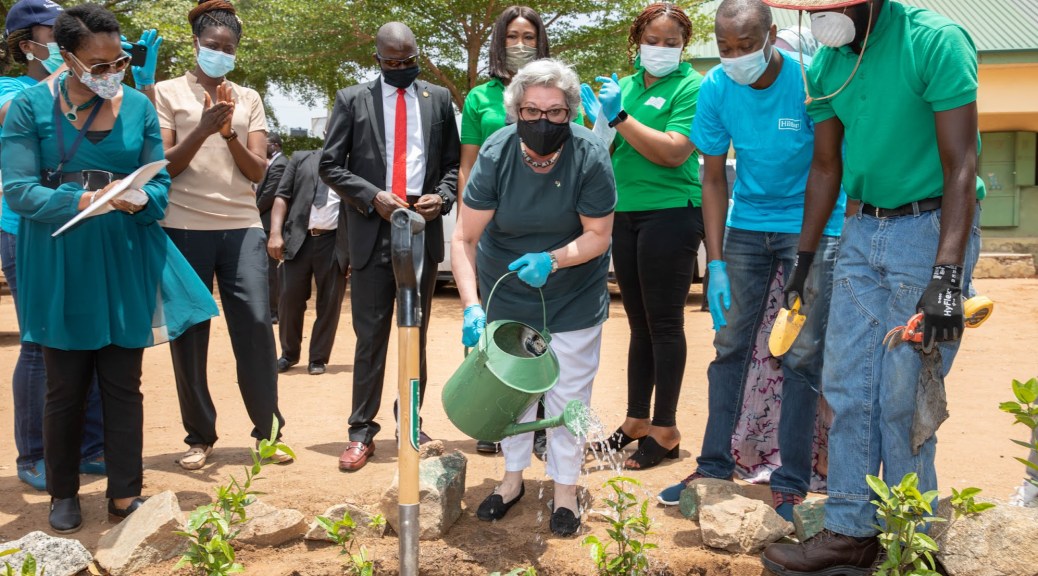
To commemorate World Earth Day on April 22, 2021, the U.S Embassy’s Green team, led by Ambassador Mary Beth Leonard and Deputy Chief of Mission Kathleen FitzGibbon, visited the LEA Primary School in Gwarimpa to meet the 20 ECO-Scholars sponsored by the Embassy’s recycling program, plant trees, educate the children on the need to recycle, and donate school supplies and learn about the progress of the 20 ECO-Scholars sponsored by the recycling program. The Embassy will plant 20 trees to represent the 20 Eco Scholars sponsored by the Green Stripe Initiative program.

Ambassador Leonard noted, “There is no greater way to put words into action than to witness the transformation of American recyclables into the bright eyes of Nigerian students. As the United States convenes the Leaders’ Summit on Climate today, we recognize that only together with government, the private sector and civil society can we succeed in reducing emissions and transitioning to welcome the benefits of climate action including job creation and innovation.”

The Green Stripe Initiative’s focus has been on increasing efforts to recycle paper, glass, cardboard, and plastic. While great strides have been made in this regard, Green Stripe will additionally focus on other tangible areas of impact such as energy consumption, waste disposal, and water usage. With each step along the way, GSI seeks greater community involvement as we focus on a greener Earth for all.

On the recycling front, the Embassy has been working with a local partner, Chanji Datti, who collects recyclables and converts them into raw materials for further use. To this end, revenues generated from recyclables collected from Mission members, have been used by Chanji Datti in conjunction with the Flexisaf foundation to support 20 ECO-Scholars at the LEA School in Gwarimpa, Abuja.

The embassy commends Transcorp Hilton for supporting this year’s World Earth Day by providing additional trees to plant. This affirms the importance of the public and private sectors working together to reduce emissions and to combat climate change.

U.S. govt supports additional 45,000 people living with HIV in Oyo, Ondo States

By sdnonline

The, U.S. government will identify and place an additional 45,000 People Lving with HIV (PLHIV) in Oyo and Ondo states on life-saving antiretroviral treatment as part of efforts to move Nigeria towards HIV epidemic control.

The U.S. President’s Emergency Plan for AIDS Relief (PEPFAR), administered by the U.S. Centers for Disease Control (CDC), is providing HIV treatment to more than 23,000 PLHIV in Oyo State and over 12,000 PLHIV in Ondo State.

United States Consul General Claire Pierangelo disclosed this during the launch of the HIV Antiretroviral Treatment (ART) Surge programs in Oyo and Ondo States which held on Wednesday and Thursday respectively.

“The PEPFAR Antiretroviral Treatment (ART) Surge program identifies people living with HIV and places them on treatment for life. HIV treatment not only reduces HIV-related illnesses and death but also helps prevent new infections,” Pierangelo remarked.

Speaking during a courtesy and advocacy visit to the Ondo State Government House, Pierangelo thanked Deputy Governor Lucky Aiyedatiwa and senior members of the administration for their commitment to work with all stakeholders, as the state implements the PEPFAR ART Surge.

She urged the Ondo State Government to remove all barriers hindering people living with HIV from accessing free services offered by the U.S. government through the PEPFAR program. Specifically, she highlighted the negative effect of user-fees as a major barrier to PLHIV accessing treatment and urged the elimination of such fees. In addition, she advocated removal of antenatal care charges for pregnant women living with the virus.

In Oyo State, Consul General Pierangelo met with the Secretary to the State Government, Mrs. Olubamiwo Adeosun, who represented Oyo State Governor Seyi Makinde. They discussed the U.S. government’s PEPFAR support in Nigeria’s policy development, human capacity building, and strengthening health systems, including the provision of state-of-the-art laboratories and pharmaceutical warehouses.

While in Ibadan, the Consul General also visited the University College Hospital where she toured the U.S. CDC-supported ART clinic, as well as interacted with program beneficiaries and management staff of the facility.

Pierangelo requested Oyo and Ondo state governments to prioritize the procurement of additional HIV test kits to support the current PEPFAR efforts. The additional test kits are necessary for identifying PLHIV in various communities, and the rapid and sustained effort to put them on life-saving medications. This effort will ensure that they live normal, productive, and healthy lives, and break virus transmission.

In 2020, despite the COVID-19 pandemic, more than 8.2 million people received PEPFAR­-supported HIV counseling and testing services in Nigeria. In each week of 2020, the U.S. government, through PEPFAR helped place 6,000 newly identified HIV-infected Nigerians on treatment, while also supporting quality HIV services for over 1 million HIV-infected Nigerians already in PEPFAR-supported care.

Furthermore, more than 1.2 million pregnant women received HIV testing and counseling to prevent mother-to-child transmission, and about 1.3 million orphans and vulnerable children received PEPFAR-supported care and supportive services.

In Nigeria alone, the U.S. government has invested more than $6 billion in the national HIV/AIDS response, toward supporting both national and state governments to identify and treat people living with HIV.

LASG to partially close Opebi road for construction of collector drain

By sdnonline

The Lagos State Government will partially close Opebi Road for the next stage of construction of the Collector Drain that will deflood the corridor for two weekends, starting from Friday 23rd to Sunday 25th of April and Friday 30th April to Sunday 2nd May, 2021.

In a statement by the Commissioner of Transportation, Dr. Frederic Oladeinde said that the next phase which has been indicated as the final stage by the contractor would require introduction of Box Culvert across Opebi road by Chrisland School.

He explained that the first half of the culvert will commence on Friday night, 23rd and be completed on Sunday, 25th of April, while the second and final half of the culvert will start on Friday 30th April and finish on Sunday 2nd of May, 2021.

The Commissioner also disclosed that the lane under construction will be barred from vehicular movement as a counter flow would be created on the other lane to allow vehicles access their desired destinations.

The statement further assured that Traffic Management Personnel will be on ground to manage movement during this period while seeking the cooperation of motorists to minimize inconveniences during the course of the construction.

The State Government once again appeal to the motoring public to obey all traffic laws and employ patience and calm in their use of the road during and beyond construction durations.

Lawyers urge FG to domesticate regional and international instruments on the safety of journalists

By sdnonline

Participants rising from a Litigation Workshop for Lawyers on the Safety of Journalists have called on the Federal Government to take urgent steps to domesticate relevant regional and international instruments and standards on the safety of journalists in order to give impetus to compliance and enforcement processes at the national level as a way of ending impunity for crimes against journalists.

They also urged government to live up to its international treaty obligation to guarantee the safety of journalists and other media practitioners, including by preventing attacks on them whenever possible and ensuring that all attacks on journalists and other media workers are investigated and that the perpetrators of the attack are prosecuted and punished.

These were some of the recommendations made by legal practitioners who participated in a two-day Litigation workshop on Safety of Journalists held in Abuja organized by Media Rights Agenda (MRA) with support from the Global Media Defence Fund (GMDF) through the United Nations Educational, Scientific and Cultural Organization (UNESCO).

The participants urged media organizations in Nigeria to undertake periodic and regular safety training for their journalists and other workers to ensure that they are able to carry out their work safely and professionally, adding that the organizations should also kit journalists and workers with the appropriate equipment, including protective gear, where necessary, to prevent or minimize their exposure to various hazards that they may confront as they carry out their work.

They advised lawyers and civil society organizations to liaise with relevant organizations, institutions and agencies, such as the National Judicial Institute (NJI), the Nigerian Institute of Advanced Legal Studies (NIALS), the Nigerian Bar Association (NBA) as well as the heads of various courts in organising sensitization programmes and activities for judicial officers on the safety of journalists so that judges are appropriately informed about the importance of the safety of journalists and their role in the process.

The participants suggested that lawyers litigating cases touching on the safety of journalists and other media workers should prepare their written addresses or briefs of argument with the objective of enlightening and sensitizing the judge handling such matters about the issue of the safety of journalists, adding that they should also prepare diligently for their cases and familiarize themselves sufficiently about the issue in order to adequately respond to questions or queries that the judges may raise.

In order to ensure speedy adjudication, the participants pointed that for cases touching on the safety of journalists in Nigeria as well as to ensure that judges handling such matters have the requisite knowledge and expertise, the heads of various courts in the country should designate judges to hear cases on the safety of journalists.

Besides, they said, as part of efforts by Nigeria to meet its obligations under regional and international instruments to prevent attacks against journalists and ensure accountability for any such crimes, “Practice Directions” should be issued to guide the hearing and determination of such cases in order to improve the effectiveness of judicial mechanisms in addressing the challenge of crimes against journalists.

The participants said it was a shocking irony that attacks on the media, particularly the killing of journalists, have escalated during the period of civilian democracy with the result that attacks on journalists have risen far above the levels recorded during the period of military regimes in Nigeria, pointing out that it means that the democratic environment has become far more hostile and dangerous for journalists than the period of military rule.

They pointed out that if journalists are frequently intimidated into distorting the information that they provide to the society or if they are too afraid to report truthfully and accurately because of constant attacks, legal practitioners and the entire society will be worse for it because most, if not all members of the public make serious and sometimes life-changing economic, political, professional and other decisions based on the information that they receive through journalists and the media.

In the light of this, the participants noted, lawyers have a self-interest in ensuring that journalists and the media have a conducive and enabling environment to practice their profession so that they can continue to provide members of the public with news and information that is reasonably accurate and reliable and that in turn enables the lawyers and other members of the public to make good and informed decisions.

Nigeria lacks adequate shelters for victims of GBV, violated women, girls

-By Funmi Falobi @ sdnonline

While nations of the world grapple with the issue of gender-based violence (GBV), the challenge has however increased as the world battles with the coronavirus pandemic. With the Covid-19 pandemic, there has been increase in sexual harassment, rape and violence against women and girls and the number has risen during the lockdown globally. The United Nations has called it ‘shadow pandemic.’

Like the rest of the world, Africa is not spared in the increase of gender-based violence. Liberia recorded a 50 percent increase in the first half of 2020, which is 0ver 600 reported rape cases. In Kenya, almost 4000 school girls were reported becoming pregnant during the lockdown. South Africa which is said to have the highest statistics of GBV in the world also experienced upward trend in violence against women during the lockdown.

Data also reveals that Nigeria records monthly increase of gender based violence during the lockdown.

While the Federal Government of Nigeria has ratified multiple international laws and conventions to address the historical discrimination and marginalization of women and girls, including GBV, the problem is still there.

Amidst the growing statistics, a major need of abused or violated women and girls is a home that provide succor to assuage their plight.

According to an ongoing research by leading GBV response organization, Project Alert, Nigeria has less than 20 women’s shelters and even then, private organisations and religious institutions run them.  Despite Nigeria having the largest population in Africa, it lacks adequate shelter to cater for the needs of victims of gender-based violence. Indeed, the provision of shelter for victims of GBV by the Government is extremely inadequate.

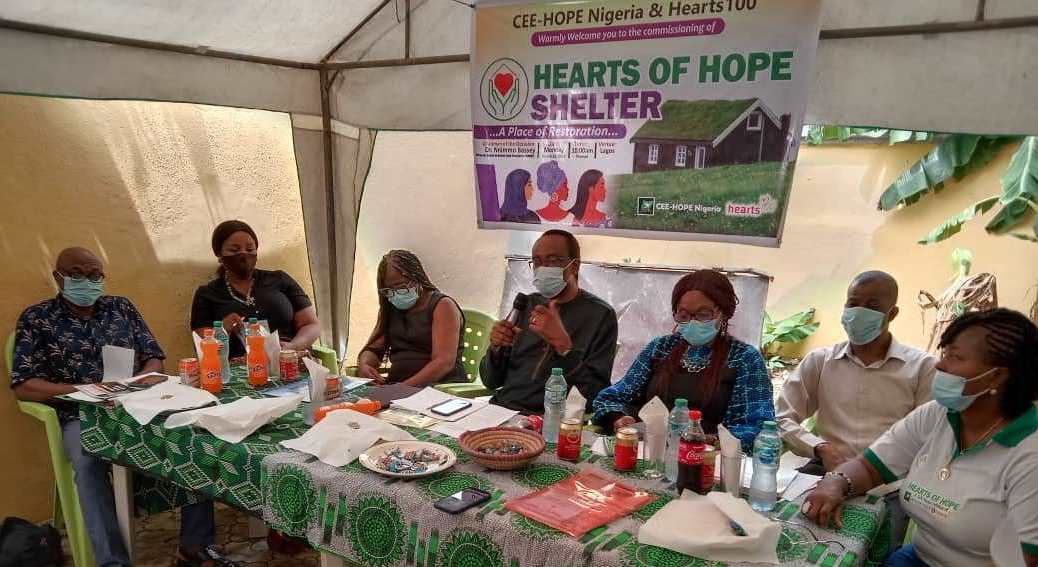
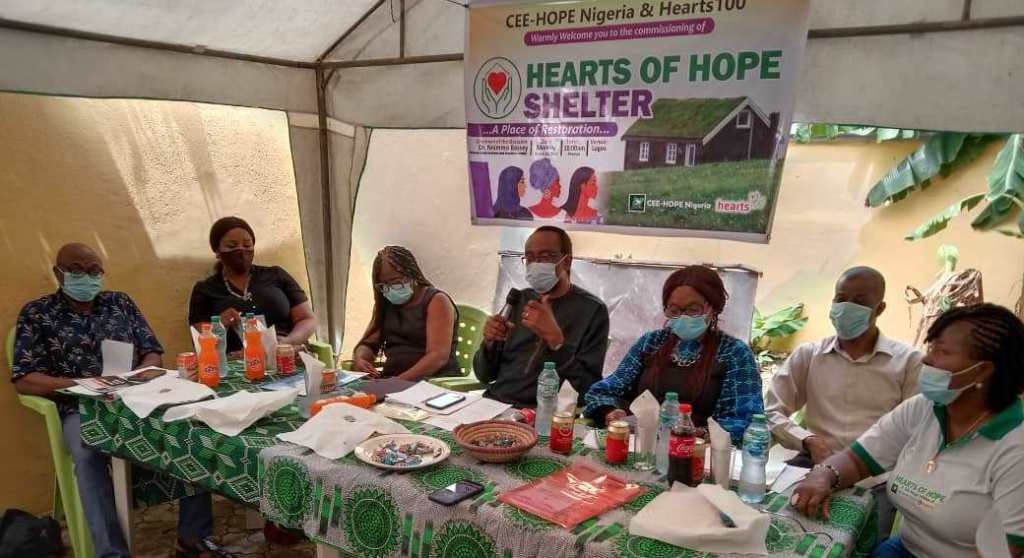
As part of efforts to ameliorate the suffering of victims of GBV and provide succour for them, the Centre for Children’s Health Education, Orientation and Protection (CEE-HOPE and HEARTS100 Initiative has established a Heart of Hope Shelter, a home to provide temporary shelter, counseling support and empowerment for affected women and girls.

Speaking at the commissioning of the home in Lagos, Executive Director, CEE-HOPE, Betty Abah  declared that when you compare Nigeria population of over  200 million to developed nations of Canada and United Kingdom with population of 37 and 66million respectively, Nigeria can only boast of  less than 20 shelters while Canada has 400 women’s shelters and UK has over 300 shelters  aside homeless and animal shelters.

This is a screaming clarion call to our government at the various levels, private institutions, and public-spirited individuals to take the need for setting up of shelters as a major priority.

Government shelters are very, very few and far in-between. As it is with government business, even the very few run by government are mostly on life support. Most of them are perennially deprived of qualified staff, food for residents and generally running at low and negligible budgets, if ever they exist. Besides the Lagos State and Ekiti State governments, which are doing credible work in response to GBV and have some of these infrastructure and legal mechanism in place, most other states in Nigeria are performing woefully in that front, “she said.

She explained that many women and girls are still trapped in the age-long practice of Female Genital Mutilation (FGM) but due to government’s failure to implement and enforce available laws, the practice still thrives in most states.

As we all know, Covid-19 has come, not only as a killer of humans and destroyer of the global economy, but has also led to a global spike in GBV. Incidences of Intimate Partner Violence, physical battery, sexual violence and all sorts of domestic violence arise. It is for this reason that GBV has long been tagged ‘an epidemic within an epidemic’ and as usual, women and girls are the major victims.”

In his address, Dr. Nnimmo Bassey, Director, Health of Mother Earth Foundation (HOMEF) as well as representative of Heart100 harped on relationship as the most valuable thing with other people.

Heart100 came into existence last year due to situations around vulnerable women and children around the world as a result of covid-19. The founders continue to ensure all can live in dignity and make their voice heard.”

Mrs. Josephine Evah-Chukwuma, Executive Director, Project Alert and founder of the first women shelter in Nigeria, Sophia’s Place charged the founder of the shelter that passion and commitment will see her through.

While confirming the dearth of shelters in the country she said, ” It’s not going to be an easy thing. Shelters are one of the needed facilities for victims of GBV but passion and commitment will see you through.”

PPJ urges govt to implement, strengthen gender sensitive laws

=By sdnonline=

The Priests Peace and Justice Initiative (PPJ) joins the rest of the World to celebrate the International Women’s day (IWD) and calls on Nigerians to challenge gender inequality and the Federal Government to implement and strengthen gender sensitive laws that will provide support for gender issues and eliminate gender discrimination in Nigeria.

In a press statement issued in Abuja by Dr. Otive Igbuzor, Programme Director, to commemorate this year’s international women’s day, the organization said “Women all over the world want and deserve an equal future free from stigma, stereotypes and violence; a future that’s sustainable, peaceful, with equal rights and opportunities for all. To get us there, Nigeria needs women at every table where decisions are being made.”

In this year’s International Women’s Day, PPJ wants to celebrate the exceptional work of women around the world; especially the Christian Women Against Corruption which is one of the campaign platforms for the Shun Corruption Project for setting a positive example, showing that women are not only victims of corruption, but also key players in the struggle against it.

According to him while corruption affects people across all genders, ages and races, it hits poor and vulnerable groups the hardest, especially women. Gender-specific forms of corruption deepen inequality, hinder women’s empowerment, and are a violation of human rights.

He said that although women’s full and effective participation in all areas of life will drive progress for everyone, women are still underrepresented in public life and decision-making processes saying at the current rate of progress gender equality among Heads of Government will take another 130 years. “When women lead, we see positive results and women, especially young women, are at the forefront of diverse and inclusive movements online and on the street for social justice and gender equality in all part of the world. Yet, women under 30 are less than 1 percent of parliamentarians worldwide,” he said.

Expressing support for this year’s theme, he said the IWD is a rallying cry for Nigerians to choose to challenge gender bias and stereotypes saying that individually, we are all responsible for own thoughts and actions – all day, every day. We can all choose to challenge and call out gender bias and inequality and collectively, we can help create an inclusive world.

Dr. Igbuzor also stated that; “the marginalization of women in economic development and in social and political spaces is a worldwide phenomenon; however, it is worst in developing countries. In Nigeria, despite the adoption of the United Nation’s convention on the elimination of all forms of discrimination against women in 1985 and similar local policies, such as the National Gender Policy of 2006, inequality still exists due to myriad of cultural and structural challenges.”

He emphasized that this has constrained women’s participation in all spheres of life with serious implication for human resource development and, in that capacity, economic development of the country and the general state of gender equality and referred to research over the years which has shown that women lay behind men in most indicators of socio – economic development and they constitute most of the poor, the unemployed and the socially disadvantaged.

According to him, the Nigerian Constitution which abhors and prohibits gender – based discrimination, does not protect women’s rights. He said an ideal Constitution should have been drafted with the input of every segment of society, but the 1999 Charter was made without consulting Nigeria’s women, and its language reflect this imbalance. Citing Section 26 of the Constitution he said that a foreign woman married to a Nigerian man is eligible for Nigerian citizenship, but the same right is not granted to a foreign man married to a Nigerian woman.

He argued that the adherence to customary laws reinforces practices that are unfavorable to women, including those relating to freedom of movement, marriage and inheritance. He took a journey backward in time to reflect on a bill to abolish all forms of discrimination against Nigerian women which was considered in the mid – 2000s, but was never passed by the National Assembly; an Act which he believed would have been a giant step towards redressing inequalities between men & women.

Stating the importance of gender equality and the empowerment of women, Dr Igbuzor said; “Gender equality is fundamentally linked to sustainable development and is vital to the realization of human rights for all”. The overall objective of gender equality is a society in which men and women enjoy the same opportunities, rights and obligation in all sphere of life. Gender equality benefit everyone and it has been conclusively shown to stimulate economic growth which is crucial for developing countries like Nigeria.

He urged all Nigerians to join this year’s campaign theme #ChooseToChallenge; for a challenged world is an alert world saying from challenge comes change, so let’s choose to challenge from today. “Individually, we are all responsible for our thoughts and actions all day, everywhere. We can actively choose to challenge stereotypes, fight bias, broaden perceptions, improve situations and celebrate women’s achievement” he said