All posts by socialdevelopmentnews

I am Funmi Falobi, Development Journalist, PR professional, Social Entrepreneur and lead contributor/Editor, Social Development News. Beyond journalism, I am also passionate about advancing social causes and empowerment, especially for children, youth and women.

Media, CSOs partner to report abandoned corruption cases

– By Funmi Falobi –

As Nigeria intensifies the fight against corruption, a select of media professionals and civil Society Organizations (CSO) across Nigeria are partnering to bring to limelight, abandoned and hibernating high profile corruption cases under an initiative entitled,   “Reporting Until Something Happens (RUSH)”.  The  initiative which recently commenced with a 3-day CSO/Media case tracking and judicial performance oversight workshop in Enugu aims to increase reporting on hibernating high profile corruption cases  in order to engender public demand for speedy completion and as well get the government to prioritizing the cases in its anti-corruption agenda.

Speaking at the workshop organized by the Department for International Development (DFID) and supported by the British Council,  Emmanuel Uche, Anti Corruption Programme Manager, Justice for All (J4A) said that since the inception of the Economic and Financial Crime Commission (EFCC), only eight high profile cases have so far been convicted, adding that out of the eight,  one was upturned by the court making it only seven convicted, thus there is the is need to bring to the front burner these cases that are either hibernating or gone to sleep in the country.

“Most of the cases with the EFCC are either been stopped, hibernated or swept under the carpet. This can only be so on sheer impunity”, he said. He noted that there is need to empower the media and civil society organizations to take up high profile corruption cases as well as for the judiciary to be up and doing.emmanuel
“For the anti- corruption campaign to be successful, the judiciary must demonstrate independence, impartiality, integrity, accountability and transparency to sustain the rule of law.

“Judiciary is arbiter of not only democracy but political, social and economic development. Nobody will come to the economy where there is no rule of law, respect for rights. For there to be government of the people, by the people and for the people, there must be a rule of law in place, if not, forget political development”, he added.

According to him: “Judicial systems need to provide timely access to fair and impartial judicial services and uphold the rule of law consistently.”

emekaSimilarly, Emeka Ononamadu, Executive Director, Citizens Center for Integrated Development and Social Rights (CCIDESOR) called for synergy between the media and the CSO in the fight against corruption in the nation.

walterAlso speaking, Dr. Walter Duru, Executive Director, Media Initiative against Injustice, Violence and Corruption (MIIVOC) urged the media to sustain reportage of corruption and humanize effect of corruption in the society in order to engage citizens in the fight against corruption.


 

Education grant: 20 students get Gani Fawehinmi scholarship

– By Tobi Oyetunde –

It was pleasant moments for 20 Students across Nigeria universities who received the 2016 Annual Gani Fawehinmi Scholarship.

The lucky students who receive the 2016 awards of a cash prize of 100,000 naira each include: Ajewole Thomas Adeyemi (University of Ibadan), Akinsanya Damilola John (University of Ibadan), Akorede Adelupe IIiyas (University of Lagos), Ariyibi Ahmod Babatunde (Bayero University, Kano), Ashiru Fatai Aderoju (Federal University of Agriculture, Abeokuta), Ephraim Jeremiah (Abubakar Tafawa Balewa University, Bauchi). Others are Eyam Rita Esighetti (University of Calabar), Folorunsho Abidemi Bashiru (Federal University of Agriculture, Abeokuta), Goji Joy (Ahmadu Bello University, Zaria), Kalu Kinsley Samuel (University of Calabar), Michael Faith Eloho (University of Calabar), Moshood Yusuf Lere (University of Ibadan), Okezie Nina Chidinma (Michael Okpara University), Okorie Uchechukwu Victor (University of Lagos), Olofinnika James Adewole (Obafemi Awolowo University).

The annual awards, which began in 1973, and has served as source of empowerment to over 800 students since inception was also used to celebrate and remember the legacy of Late Gani Fawehinmi. The event was celebrated with the theme, ‘Education in the Age of Neoliberalism: Local and External Contexts’.

gani-schorlaship-jpg2

Speaking at the event, Mr. Oladipo Fashina, Chairman of the Gani Fawehinmi Scholarship awards Board reiterated that the principle of late Chief Gani Fawehinmi must not be forgotten. While addressing the university students present, Mr. Oladipo advised them to be sincere and put more energy into their education.

He said, “we must never forget the principle of Gani and what he lived for. We must follow his legacy in improving the education sector of the country in any capacity we can. Education is a right which must be exercised by all Nigerians with real equality of opportunity, such right must be to a free education, free education is capable is capable of ensuring political stability and every Nigeria youth must e educated so that he may be free to live a dignified and useful life.”

The guest speaker at the ceremony, Dr. Sylvester Odion Akhaine, Senior Lecturer in the Department of Political Science, Lagos State University lamented how policy made by government is killing education and encourage everybody to fight for their right.

“The fact that politicians now showcase red roofs in primary and secondary schools is an indication of the decay in that sector during the adjustment years. The short of it is that the structural advancement policy has endangered unprecedented levels of peonage in Nigeria’s history, economic underdevelopment”, he noted.

He concluded by saying, “we must rescue the educational sector from its present paralysis, free it from policy summersault, underfunding and the spasm of massification underlined by the illusion of choice and banking approach based on memorization.”

gani-schorlaship-jpg2-jpg3

Towards 2019: Stakeholders task Buhari on credible elections

– By ‘SANMI FALOBI-

Against the backdrop of the old adage that, ‘he who fails to plan, plans to fail’, stakeholders have tasked the Buhari administration to show more commitments in consolidating the gains of the 2015 elections by ensuring that the Independent National Electoral Commission (INEC) is properly constituted and given the enabling operational requisites to be able to conduct credible elections, especially ahead the 2019 general elections.

According to the stakeholders, beyond the present administration’s overt commitment to fighting corruption, the administration should also be equally committed to ensuring that the democratic processes are transparent and credible, in order to entrench the gains on the credibility and transparency demonstrated by INEC in the 2015 elections.

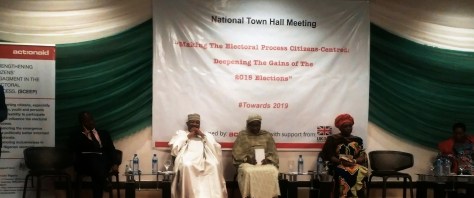
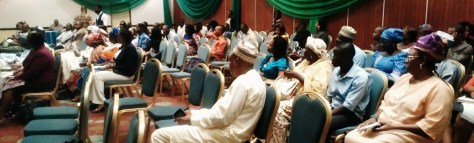
Sharing perspectives as panelists in a national town hall meeting in Abuja, civil society stakeholders, opinion leaders and other key electoral stakeholders were of the opinion that more needs to be done if INEC is to be able to deliver credible elections come 2019.

In her opening remarks, Ojobo Atuluku, the Country Director of Actionaid, organizers of the event, said the town hall meeting which was also used to publicly present the outcome of a 2015 post election survey report conducted by Actionaid under its Strengthening Citizens Engagement in Electoral Processes (SCEEP) project, was to create an opportunity to connect the people, citizen groups and policy makers to dissect issues to deepen the gains of the 2015 elections as well as on steps to conducting more credible elections in the future.

IMG_20160831_124144

Speaking on the central theme, ‘Making the electoral process citizens-centred: Deepening the gains of the 2015 elections’, former Chairman, National Human Rights Commission, NHRC, Chidi Odinkalu, said that elections may not hold in 2019 as there may be crisis and death if there are no adequate preparations to ensure that the elections are credible.

Today, the executive has gone into lax mode; judiciary has become lawless; National Assembly is lacking in credibility; INEC is troubled; politicians have gone unruly. Government says it has no money to run the economy. Every element that made 2015 is currently missing,” he said.

According to him, it was worrisome that key portfolios of personnel and designations in INEC have been left vacant.  “There is absolutely no reason why the executive should allow the number of vacancies we have in INEC to be.”

“INEC is having a challenge. By next month, INEC will be having 28 vacancies among its RECs (Resident Electoral Commissioners) and seven commissioners. The Executive is carrying on as if this normal. It isn’t”, he added.

According to him, “continuing the way we are going, we will not be able to have elections in 2019. If it happens, there would be too many broken heads and dead people.”

In a related contribution, Clement Nwankwo, Executive Director, Policy and Legal Advocacy Center (PLAC) and Convener, Civil Society Situation room noted that all hands must be on deck to build on the gains of the successes of the 2015 elections. According to him, the civil society must continue to do the work they can to ensure that the democratic governance is deepened, adding that the country is presently in a national emergency as the  electoral body does not have the full complement of electoral commissioners needed for the  general elections.

Nigeria is in an emergency situation. In less than two and half years to the 2019 elections, INEC does not have the full complement of electoral commissioners. The question then is why is the delay? … If we continue this way, we shall lose our democracy. So we must act. If those in government do not act with urgency, we will lose this democracy“, he declared.

Similarly, other perspectives were given by stakeholders which included representatives of other civil society groups, namely; Ekaette Umoh, National President, Joint National Association of Persons with Disabilities (JONAPWD) Abiodun Ajijola of Election Monitor, Ezenwa Nwangwu of Partners for Electoral Reform and Samson Itodo, Head Research Policy and Advocacy, YIAGA, who spoke as an advocate of the #NotTooYoungToRun campaign.

While calling for collaboration of all stakeholders, Amina Zakari, INEC National Commissioner in charge of election operations, noted that the attaining credible elections involves all.

In 2015, for the first time, Nigerians believed they could effect a change in our political system. There was also dedication in the part of INEC, Security agencies and civil societies who spoke in one voice”, she said.

Democracy and elections is for all and by all; everyone, not just INEC or politicians”, she added.

In the same light, the Chair, Senate Committee on INEC, Abubakar Kyari who agreed that democracy was about the people told the gathering that the Senate was working to ensure that the electoral laws are amended to ensure credible elections.

We have sought for suggestions from the general public in order to fashion out an amendment in the electoral system. Our plan is to get our electoral reforms ready before December and have the president sign it into law”, he said.

IMG_20160831_124301.jpg

Connect with government on grassroot development, Lagosians urged

By Funmi Falobi-

Lagos residents have been urged to be involved in government activities in order to bring development to their communities.

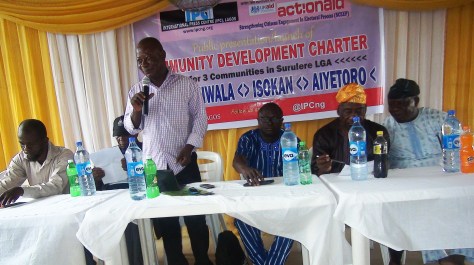
This was disclosed at the public presentation of Community Development charter for three communities; Obele Oniwala, Isokan, and Aiyetoro communities in Surulere local government area of Lagos State. The programme was organised by the International Press Centre (IPC) with support of UKAID and ActionAid Nigeria.

Speaking on the topic entitled “Enhancing Grassroots Development: Bridging the Gaps Between Government and Community Stakeholders” Abiodun Aremu, rights activist and Secretary General, Joint Action Forum (JAF) said people must be interested in what is happening around them for development to take place in their communities.

“Development must start with self. You must have interest in what is happening for development to take place in your communities”, he said.

He called on the grassroot community stakeholders to appreciate the enormous constitutional power they have and that they can use that to make government develop the grassroot communities.  According to him: “Development works when it is for all of us. Our community’s values have broken down so we have to get them back”.

He noted that it takes community effort to get development at the grass root. “As grassroots people, we must first recover our values. Anything we want, we must get it from Government and they are not doing us any favour”.

He urged the government to always consult with community members before implementing its policies. “Every development and policies must come from the people and that is how people living in communities can be further empowered to drive development”. He said.

“The poor man has one vote, the rich man has one vote, if the vote is equal, development should be equal” he added.

Similarly, the Chairman of Community Development Association in Surulere Local Government, Abayomi Balogun, corroborated that there can never be democracy without grassroots participation and development.

“Grassroots development is very important and that is why the local government election coming is our election. The state and the federal elections in the country are not our elections; the local government election is our election because that is the tier of government that collects all sorts of levies and taxes from us, so we must be involved,” he said.

DSC00027

Celebrating Funke Egbemode as NGE President

-By FUNMI FALOBI-

Female journalists in Nigeria do have reasons to hold up their head in high esteem following the recent election of Mrs. Funke Egbemode as the substantive president of the Nigerian Guild of Editors (NGE) at the guild’s 12th annual conference in Port Harcourt

Egbemode, who is the Managing Director and Editor-in-Chief, New Telegraph Newspaper, becomes the second female journalist after late Mrs. Remi Oyo who was president of the guild between1999 and 2003.

Speaking on her confirmation, the astute journalist who in July was nominated president in acting capacity declared: “For the time I will be in the saddle, the guild will change for the better, will become more visible.”

Expressing her gratitude, she said, “I feel honoured and I feel like that I have just been handed a big responsibility, like a big board that must not drop. I urge members to keep the flag flying. We have done very well as a body. We should continue to do things that will elevate the Guild, whatever will promote journalism, whatever that will promote the body.”

Those who are familiar with her, describe her as a seasoned journalist who has worked in different media houses at the top management level. Egbemode started her career as a staff writer in the defunct Prime People magazine. She moved to The Punch in 1993 where she rose to become the Deputy Features Editor. In 2000, she was appointed Editor of The Post Express on Saturday. She was also the pioneer Saturday Editor, Independent Newspaper; Sunday Editor, The Sun Newspaper and later General Editor of the newspapers, a position she held until her appointment as Managing Director/Editor-in-Chief of the New Telegraph Newspapers in 2015. She had also served as the Special Adviser (Media) to the former Speaker, House of Representatives, Patricia Olubunmi Etteh.

Born in Ijabe, Osun State, Egbemode attended Baptist Practising Primary School, Iwo and Baptist Girls High School, Osogbo. She holds a Bachelor of Arts degree from the Obafemi Awolowo University, Ile Ife. She also holds a Post-Graduate Diploma in Journalism from the Nigeria Institute of Journalism, Lagos.

In a congratulatory message, the Governor of Lagos State, Mr. Akinwunmi Ambode described her emergence as an inspiration to other women.  “I have no doubt in my mind that the cap fits Mrs. Egbemode. She has a proven track record of excellence in journalism, which has seen her rise through the ranks to the pinnacle of the profession”, the Governor said.   “I urge Mrs. Egbemode to see her new assignment as one that comes at a time in our national life where we need the media to be more circumspect and developmental in playing its role as the watchdog of the society,” he added.

The Senate President, Dr. Abubakar Bukola Saraki, described her emergence as “a square peg in a square hole”. He noted, “Mrs. Egbemode is not just a technocrat and media executive of repute, she is a professional par excellence. She is a living example of the saying that ‘what men can do, women can do better.”

The Ogun State Governor, Senator Ibikunle Amosun described her emergence as “a well deserved honour.” He noted: “Anyone who has followed the career path of Egbemode over the years will not be surprised at how far she has come in her chosen profession of journalism.”

Hope rises for IDPs as U.S. provides assistance to Lake Chad Basin Region

> By FUNMI FALOBI<


Reprieve is in the offing for over five million Internally Displaced Persons (IDPs) as the United States government, through its Agency for International Development (USAID) on Wednesday announced that it will provide more than $37 million in additional humanitarian assistance to people affected by the ongoing conflict and severe food insecurity in Nigeria and throughout the Lake Chad Basin.

The new funding to United Nations and Non-Governmental Organisation (NGO) partners will help tens of thousands of people receive critically needed humanitarian assistance, including food, water, shelter, and services to address acute hygiene, protection, and nutritional needs following the savagery of Boko Haram which has triggered a humanitarian crisis in Nigeria and surrounding countries in the Lake Chad Basin region.. Despite gradually improving security conditions, the humanitarian situation remains dire as families have been driven from their homes, millions are left without enough to eat, and human rights abuses are widespread. Throughout the region, approximately five million people need emergency food assistance, and 2.5 million people are displaced.

Three senior USAID officials—Nigeria Mission Director Michael Harvey, U.S. Office of Foreign Disaster Assistance Director Jeremy Konyndyk and Office of Food for Peace Deputy Director Matt Nims—made the announcement following a trip to the country’s northeast, where the humanitarian needs are the most acute. With this announcement, the United States is providing more than $318 million in humanitarian assistance since FY 2015 to the Lake Chad Basin region and continues to be the single largest humanitarian donor to the region. The food assistance will be delivered to conflict-affected communities in the Diffa Region of Niger, including populations who fled their homes following the recent attacks in Bosso. This new food assistance will be coordinated with the humanitarian community in Nigeria to scale up the overall regional food response.

In addition to humanitarian funding, USAID provides targeted assistance that seeks to reduce extreme poverty and improve the quality of life for Nigeria’s most vulnerable communities through improved governance and civic participation at the federal, state, and local levels; reduced corruption; a strengthened private sector as a source of job creation; and improved quality of social service delivery.


Photo L-R: NEMA DG Muhammed Sani Sidi and USAID Director of Foreign Disaster Assistance, Jeremy Konyndyk.

… When JOINvalue extended heart of love to Modupe Cole Memorial Home

>By Tobi Oyetunde<

Impacting lives positively, the motto of JOINValue (Jewels of Inestimable Values), a non-governmental organization came to the fore on Sunday, 3rd of July, 2016, when the founder, Miss Chichi Ogbonnaya and her team members showered love to the children of Modupe Cole Memorial Child Care and Treatment Home, Yaba, Lagos.

The visit to the home which also included donation of food items was done in celebration of Miss Chichi Ogbonnaya’s birthday as a demonstration of her passion to reaching out to the less privilege.

pix.chichi

According to her, it is better to give than to receive, especially to the less privilege.

“I know how it feels to be in a state of need as I have been there before but it is only Jesus and His grace that made me who I am today. So I prefer to give than to receive because when you give to others, God will continually bless you.” she said.


“I feel this burden in my heart to give to those who are not privileged to have what others have and that is what brought about the existence of the organization, JOINValue”, she added.

Receiving the team, a teacher in the house, Mr. Kareem welcomed the gestures of the JOINValue team to the house.


He said: “there are three types of people in the house; the educable, the trainable and the totally dependant”. Speaking further, he said: “the educable are those who have the ability to learn regardless of the fact that they are slow learners because they can not comprehend like a normal person due to their mental and psychological makeup. The trainable are those who are not educable but can be trained to learn handwork and skills, while the totally dependant are those who can not do anything on their own, can not read and write, can not learn skills and can not even eat; they have to depend on the care givers in the home.


Kareem explained that the Modupe Cole Home, which has been in existence for years is a haven for many children who have disabilities. “There are many people in the foundation who have disabilities, not only children but we also have a man of 64 years who happens to be oldest the home has accommodated”, he explained.


He noted that the inmates have challenges. “The students are slow learners and their retention is low as they forget what they are taught easily; they also go through crisis and sometimes they attack visitors when going through this crisis. Another thing is that there is not enough encouragement from the government.”


He noted that the government pays the teachers the same rate they pay normal school teachers whereas they do more work than normal school teachers. “While others work Monday to Friday, we work everyday, including weekends and public holidays”, he said.


He also lamented that parents do neglect their children in the home.

“Some parents do not want people to know they that have children that are disabled here as they see it as a thing of shame which is not suppose to be so. The government should help in changing the mentality of the people towards the disabled”, he said.


In showing love to the children, the JOINvalue team spent some time praying with the  children, shared some gifts with them and took photographs with them as a way of making them feel loved and have a sense of belonging in the society.

pix2

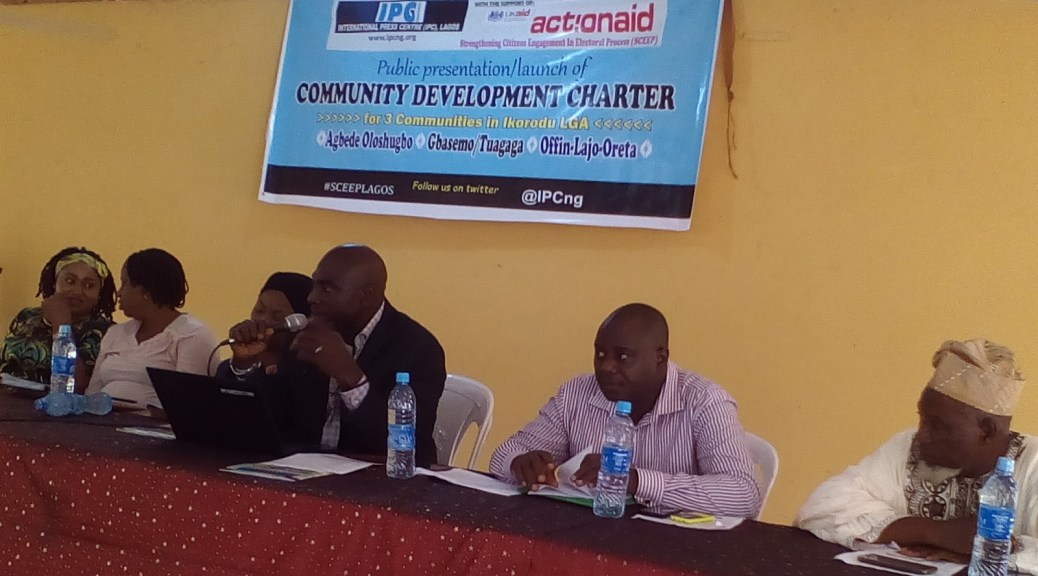
Grassroot development: Ikorodu communities gets Community Development Charter

>By Tobi Oyetunde<


“Grassroots development remains a cardinal component of global campaigns of the 21st Century. It is therefore important that the community as the epicentre of human and environmental activities should remain a recurrent decimal in the narrative of developmental agenda”.


This statement by Mr. Francis Abayomi, Executive Director, Peace and development Projects (PEDEP), aptly captures the essence of community led initiatives being implemented in Lagos by the International Press Centre (IPC) with the support of ACTIONAID Nigeria and the DFID/UKAID under a project entitled “Strengthening Citizens Engagement in Electoral Processes (SCEEP).


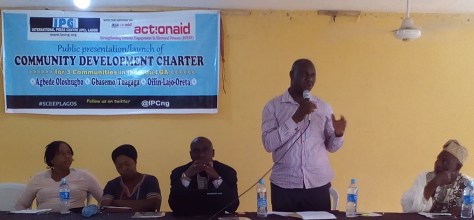
Speaking on the topic: “Community Interest vs Political Interest: Perspectives on Enhancing Grassroots Development” at the public presentation of Community Development Charters for three communities in Ikorodu Local Governement area of Lagos, namely: Agbede-Oloshugbo, Gbasemo/Ituagaga and Offin-Lajo-Oreta Communities respectively, Abayomi charged community leaders at the grass root not to insulate themselves against politics as stakeholders in community development as well as political actors are expected to work hand-in-hand rather than at cross-purposes in ensuring that the community remains on the path of steady development without negative consequences of political divisions.


IMG_20160616_125649

According to him, “a systematic approach” that creates an increased understanding and cooperation among the people and between the people and the government should be employed in advancing the development at the grassroots because development process is not unidirectional as there is need for access to information, improvement in communication and enhancement of peaceful change and sustainability of developmental initiatives.

“When the community is organized for developmental process, participation should be based on the principle of consensus building which involves dialogue, negotiation, and meditation. Everyone must be included in decision making process while transparency, openness and accountability must be encouraged through the use of a proper feedback mechanism”, he said.

IMG_20160616_130931

He however maintained that political interest of community stakeholders should not override their community interest. He said: “politics should be played in a way that it will not affect the needs of your community. As a stakeholder in the community, you must play politics with maturity in the sense that you should not place your personal and selfish needs above what will benefit the society at large”.

In fast tracking the development of the communities, he urged community stakeholders to interact and engage with duty bearers on their community development aspirations.

“The people must play the role of assessing projects, prioritizing projects, building strong teams to pursue common goals, identify key partners outside the community and build leadership capacity. As a community member, you must work for the growth of the community and make this charter which is the needs of your community known to everybody and the government”, he said.


IMG_20160616_124708

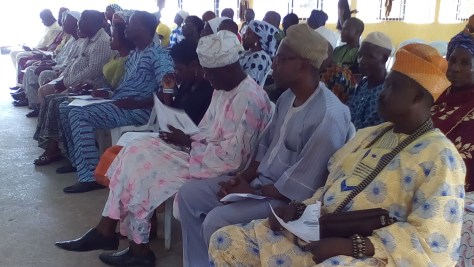
Sequel to Abayomi’s discourse, the community development charters for the three communities was then official presented to the public by the Director of IPC, Mr. Lanre Arogundade with copies received by the Senior Admin. Officer, Mrs. Olatunji Adeoye who was representing the newly appointed Sole Administrator of Ikorodu Local Government Area, amongst a host other officials from the local government. Copies of the charter were also handed over to community leaders and related community stakeholders at the event.