CEE-HOPE Hails Senate for Passing Bill on Domestic Workers’ Rights, Urges Speedy Passage by House of Reps
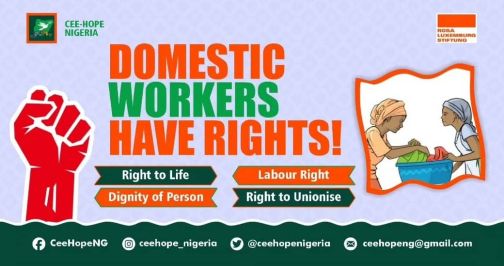
The Centre for Children’s Health Education, Orientation and Protection (CEE-HOPE) has commended the Senate of the Federal Republic of Nigeria for passing the Informal Sector Employment (Regulation) Bill, 2025 (SB.629), which seeks to protect the rights of domestic workers and other informal sector employees. The Bill was passed on the floor of the Senate on November 12.
Speaking on the development, Betty Abah, Executive Director of CEE-HOPE, described the move as “a long-overdue step toward justice, dignity, and recognition for millions of hardworking Nigerians, most of them women and girls, whose labour sustains households across the country but whose rights have remained unprotected for decades.”
According to the International Labour Organization (ILO), there are about 75 million domestic workers globally, with over 80% being women. In Africa alone, there are at least 10 million domestic workers, while Nigeria is estimated to have between 3 and 5 million, forming a significant portion of the informal workforce. Yet, the majority operate without written contracts, fair wages, or social protection, leaving them vulnerable to exploitation, abuse, and modern slavery.
Alarmingly, the ILO further estimates that 17.2 million children worldwide are engaged in domestic work — more than half under the age of 14 — with girls making up nearly 67 % of that number.
In Nigeria, several hundred thousand children, mostly girls from poor backgrounds, are believed to be engaged in domestic labour, often exposed to abuse, trafficking, and denied education and childhood.
Abah noted that beyond legislation, the protection of domestic workers requires “strong unionisation, collective bargaining, and public awareness.” She stressed that the new Bill offers an opportunity to formally recognise domestic work as decent work, aligning Nigeria with the ILO Domestic Workers Convention (C 189), which calls for fair treatment, decent working conditions, and the right to organise.
“CEE-HOPE is committed to supporting the formation and strengthening of a national union for domestic workers,” Abah added. “We believe that only through collective organisation can domestic workers effectively demand fair wages, safe workplaces, and respect for their humanity.”
CEE-HOPE called on the House of Representatives to expedite passage of its companion legislation, the Domestic Workers (Employment and Protection) Bill, 2025 (HB.1765), and urged President Bola Ahmed Tinubu to give prompt assent to make it law. The organisation also appealed to state governments, civil society, and international partners to begin preparing for robust implementation once enacted.
Since 2020, CEE-HOPE which works with at-risk young people and marginalised populations, has campaigned for Nigerian domestic workers’ rights through wide-ranging initiatives including awareness creation through multileveled media platforms, engagement of multi-sectoral stakeholders (activists, unionists, media representatives, community leaders, domestic workers, employers and others) including law makers.
“This is a defining moment for Nigeria’s labour and human-rights landscape,” Abah declared. “By protecting domestic workers, we protect the dignity of our nation.”
The past few weeks have been filled with anxious uncertainty for Agnes Umukoro, a Senior Secondary 3 student in Lagos. This follows a recent announcement by the Federal Ministry of Education introducing a revised national curriculum, alongside reports that the West African Examinations Council (WAEC) plans to begin assessing students based on it from the 2026 West African Senior School Certificate Examination (WASSCE).
“We are no longer allowed to offer some of the subjects we started with. I’m a science student and had planned to take Economics, but that’s no longer possible. On top of that, we’re being asked to take new subjects like Digital Technologies or a trade subject, which we’ve never studied before. How are we supposed to prepare for the WASSCE in just a few months?” Umukoro lamented.
Her experience mirrors the growing concerns of several SS 3 students nationwide following reports that WAEC intends to examine candidates under the revised national curriculum in 2026. The review, scheduled to take effect from the 2025/2026 academic session, introduces significant changes to WAEC’s subject combinations—sparking widespread confusion and anxiety across the education sector.
New Curriculum, New Challenges
Dr. Tunji Alausa, Minister of Education.
It will be recalled that in August 2025, the Federal Ministry of Education announced the completion of a comprehensive review of curricula for basic, senior secondary, and technical education, in collaboration with several agencies, including the Nigerian Educational Research and Development Council (NERDC), Universal Basic Education Commission (UBEC), National Senior Secondary Education Commission (NSSEC), and National Board for Technical Education (NBTE).
According to emerging details, the revised curriculum introduces mandatory subjects such as Citizenship and Heritage Studies and Digital Technologies, while consolidating over 30 trade subjects into six broad practical areas. History has also been reintroduced as a stand-alone subject at the basic education level.
Although these reforms aim to equip learners with relevant 21st-century skills and reduce subject overload, the timing has left many students facing subjects they have never been taught—alongside restrictions on those they originally selected.
Among numerous reactions, Mr Olanrewaju Akinola, a concerned parent from Lagos, described the decision as “unfair, ill-timed, and a potential recipe for disaster.” He argued that current SS 3 students—set to sit the 2026 WASSCE in just a few months—are being unfairly disadvantaged, as they have not been taught the new subjects they are now expected to take.
Mr Akinola stressed that any external examination, such as WASSCE or BECE, based on the new curriculum should commence in 2028, when the present SS 1 and JS 1 students—who started under the revised structure—will be in SS 3 and JS 3 respectively.
He noted that while the new curriculum’s inclusion of subjects such as Citizenship and Heritage Studies and Digital Technologies is commendable, WAEC’s decision to implement it by 2026 is “ill-conceived, unjust, and unworkable.”
A major concern, he said, is that students who have never studied Digital Technologies in SS 1 and SS 2 will now be examined on it. Likewise, those who have been offering subjects such as Tourism or Storekeeping since SS 1 are now required to switch to one of the six new trade areas.
“Students who have been offering certain subjects since SS 1 are now being told they can no longer take them in WASSCE. For instance, science students cannot take Economics, while business students who have been offering Government since SS 1 are now being compelled to take Marketing instead—even though they were never taught it,” Akinola noted.
He also questioned how schools are expected to generate continuous assessment (CA) scores from SS 1 to SS 3 for the newly introduced subjects, given that these were not previously taught.
Concerns over CBT Implementation
Furthermore, Akinola advised WAEC and the Federal Ministry of Education to reconsider their plan to make Computer-Based Testing (CBT) compulsory for WASSCE from 2026, citing inadequate infrastructure, poor accessibility, and logistical difficulties.
He warned that students—especially those in rural areas—would face serious challenges travelling repeatedly to CBT centres, many of which may be located far from their homes.
“Unlike JAMB, WAEC examinations are not just objective or a one-time two-hour test. They span several days and include practical components. Making CBT compulsory without adequate infrastructure will only worsen the situation,” he cautioned, noting the additional mental, financial, and logistical burdens this would place on students and parents.
“It’s stressful for both students and schools,” he added. “Parents are worried, and teachers are scrambling to align lessons with new requirements in just a few months.”
WAEC Denies Issuing Directive
Meanwhile, in response to the growing controversy, WAEC has denied issuing any directive restricting Senior Secondary students to specific subjects for the forthcoming 2026 WASSCE.
In a statement signed by Moyosola Adeshina, Acting Head of Public Affairs, on behalf of the Head of National Office, the Council described the reports as “unfounded assumptions” and urged schools and the public to disregard them.
“WAEC wishes to categorically distance itself from this unfounded assumption and the information making the rounds on the said subject. The Council did not issue any such directive(s) nor restrict students’ choice of subjects for WASSCE (SC) 2026 as alleged,” the statement read.
WAEC clarified that it does not make or alter secondary school curricula, as that responsibility lies with the Federal Government through the relevant education authorities.
“The development and regulation of curricula in Nigeria fall within the purview of the Federal Government. WAEC, as an examination body, only implements government policies through assessment,” it explained.
The Council emphasised that its role is strictly limited to conducting examinations based on government-approved curricula and within Nigeria’s educational framework.
Calls for Clarity and Sensible Implementation
Despite WAEC’s clarification, education experts, teachers, and parents continue to urge the Ministry of Education and WAEC to provide clear guidance and realistic timelines. Many acknowledge that curriculum modernisation is necessary but insist that implementation must be gradual, transparent, and aligned with students’ preparedness.
Mr Akinola maintained that implementing the new curriculum by 2026 would be “a recipe for disaster” and called on education authorities to act responsibly by deferring the examination of the revised curriculum until 2028.
“The future of our children is at stake, and we must ensure they are not short-changed by hasty and poorly planned reforms,” he said.
He urged policymakers and stakeholders to engage constructively to revise the decision in light of the emerging concerns.
“The future of our children is too important to be compromised by rushed policies,” Akinola concluded. “Students should only be tested on subjects they have actually studied. Anything less is unfair and could jeopardise their academic futures.”
………………………………………….
This special report is written by Sanmi Falobi, Guest Writer/Executive Editor, SDN news.

 Social Development News (SDN)