

The National President of the Association of Communication Scholars and Professionals of Nigeria (ACSPN), Professor Rotimi Olatunji, has reaffirmed the Association’s commitment to advancing Nigeria’s communication and media landscape through stronger collaboration among academia, industry, and government.
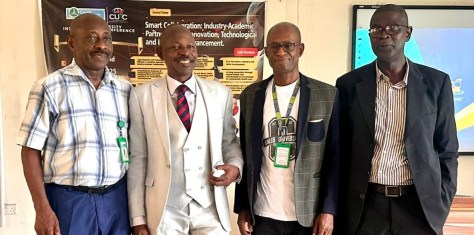
Speaking at the 2025 International Conference of Caleb University, themed “Smart Collaboration: Industry–Academic Partnership for Innovation, Technological and Industrial Advancement,” Olatunji emphasised that effective partnerships are key to building a knowledge-driven and innovation-oriented society.
Delivering a lecture titled “Enhancing Capacity Building in Communication and Media through Academic–Industry–Government Partnerships in Nigeria: A Triple Helix Approach,” the ACSPN President said Nigeria’s communication sector must embrace synergy to unlock its full potential.
“True innovation in media is not just about novelty but about creating value and impact through transformation,” he said.
Triple Helix Model as a Framework for Change
Drawing on the Triple Helix Model—which integrates universities, industries, and government agencies within a shared innovation ecosystem—Olatunji noted that such collaborations promote curriculum co-design, joint research, and experiential learning. He called for a shift from conventional classroom teaching to practical engagement, policy-oriented research, and technology-enabled storytelling. He urged the Federal Government to strengthen institutional frameworks for university–industry partnerships, while encouraging the private sector to invest in academic research and innovation.
Meanwhile, a statement issued by Dr Solomon Oyeleye, ACSPN’s General Secretary, further underscored Olatunji’s appeal for a more structured and sustainable approach to capacity building in communication and media education.
Highlighting ACSPN’s ongoing initiatives, Olatunji cited collaborations with the Centre for Journalism Innovation and Development (CJID), Dataphyte, the Ford Foundation, UNICEF, UNESCO, and the MacArthur Foundation. These partnerships, he said, have produced joint research projects, digital media training, innovation incubation programmes, and fellowships across Nigerian universities.
“Between November 2024 and now, ACSPN and CJID have trained nearly 100 scholars and professionals in mainstreaming AI into communication and media practice in Nigeria,” Olatunji revealed, describing the project as “a continuous one.”
It should be noted taht that since its inception, ACSPN has championed excellence in communication research and professional practice through initiatives such as the Empowerment Series, Eminent Persons’ Strategy Series, Value-Added Conferences, and Mentorship Programmes. These, Olatunji noted, have enhanced research productivity, professional competence, and youth engagement across the sector.
Pioneering Curriculum Reform
Olatunji also traced ACSPN’s pivotal role in the unbundling of the B.Sc. Mass Communication programme into eight distinct degree programmes—a landmark reform in Nigerian higher education.
According to him, the Association initiated the review process with support from UNICEF, organising the first stakeholder meeting at the University of Lagos with participants from the Nigerian Press Council, Nigerian Broadcasting Commission, Advertising Practitioners Council of Nigeria (APCON), and the Nigerian Institute of Public Relations (NIPR), among others.
Further progress, he recalled, was achieved through MacArthur Foundation grants managed by Professor Umaru Pate, which facilitated nationwide consultations culminating in the National Universities Commission’s adoption of the new communication degree structure.
Championing Media Literacy and Research
Through its partnerships with UNESCO and other development partners, ACSPN has also produced notable resources such as the UNESCO-supported brochure on combating fake news and promoting media and information literacy. These efforts, Olatunji said, highlight the Association’s leadership in evidence-based research, policy advocacy, and innovation in media and communication across Africa.
Despite these achievements, he acknowledged persistent challenges, including inadequate funding, weak research infrastructure, limited access to emerging technologies, and a continuing gap between academic output and industry needs.
Call for Policy Reforms and Technological Integration
In his concluding remarks, Olatunji called for robust policy reforms to position communication and media as strategic pillars of Nigeria’s national development. He also urged communication scholars and professionals to embrace continuous learning and to leverage emerging technologies such as artificial intelligence, virtual reality, and data-driven journalism to remain relevant in an evolving media landscape.
Participants at the conference commended Olatunji’s lecture for its intellectual depth and practical insights, describing it as a timely and visionary contribution to Nigeria’s pursuit of a knowledge-based, innovation-driven society.





















 Social Development News (SDN)